

INFLECTION POINTS: Can Anthony Colandrea Be More Than A Chaos Agent?
It’s well established the Huskers’ presumptive starting QB can create out of structure. Can he execute on time from the pocket to have sustained success vs. Big Ten defenses?

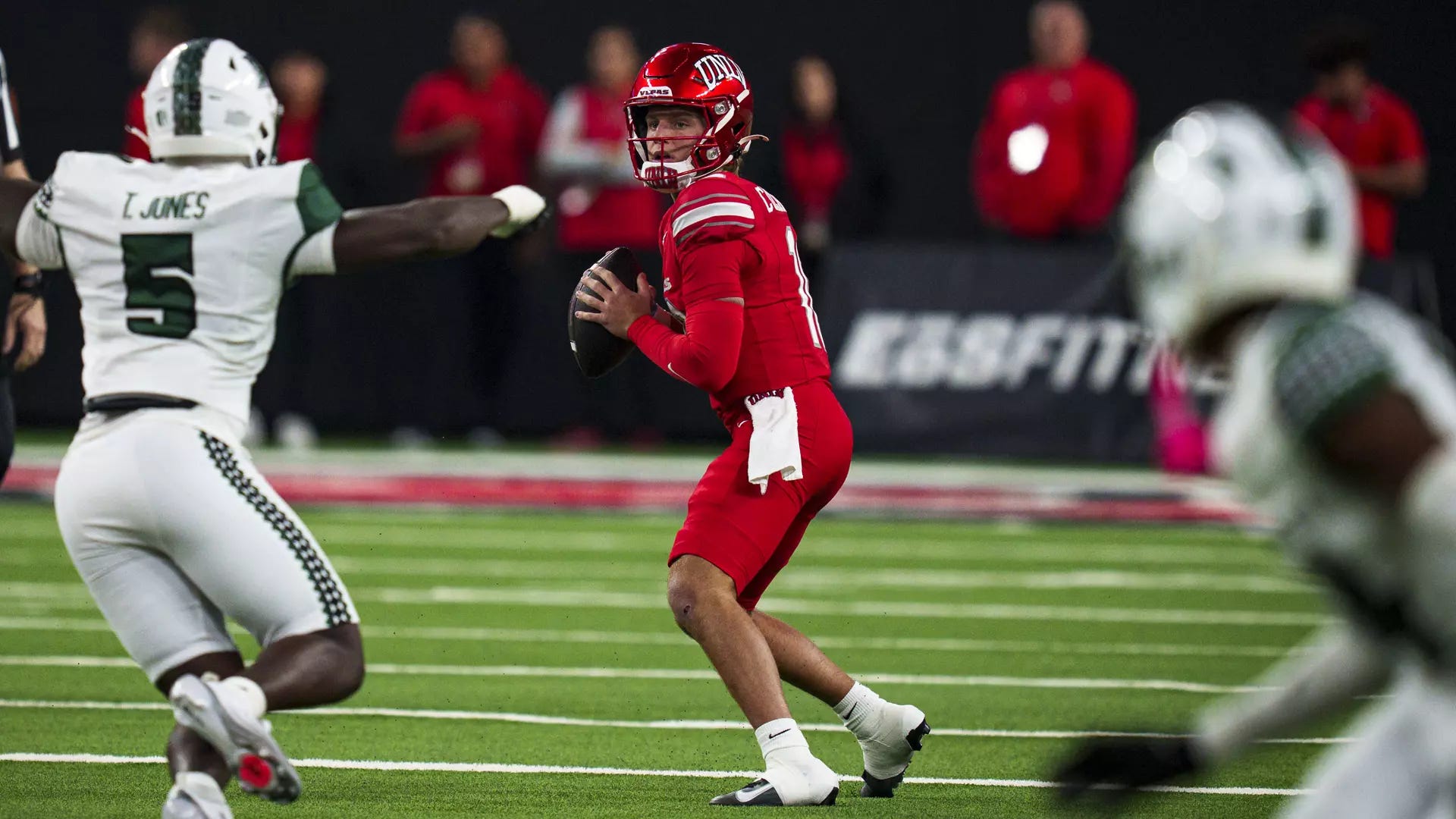
PROGRAMMING NOTE: This is an entry in an occasional offseason series of in-depth film reviews for individual players who have the potential to make or break Nebraska’s upcoming season. These posts are essentially scouting reports, meant to present the strengths and weaknesses of unknown players who will be stepping into big roles for NU. These reports examine players from a talent, technicality, and skill set perspective, meant as honest and clear-eyed evaluations. New entries will appear sporadically throughout the offseason.
PREVIOUS ENTRIES: 2025 / Elijah Pritchett, Elijah Jeudy, Dane Key
Nebraska’s program embarked on a youth movement at its offensive skill positions in 2024.
Around its new true freshman quarterback Dylan Raiola, by the end of the 2024 season, NU was starting a sophomore at tailback in Emmett Johnson, a true freshman at slot receiver in Jacory Barney Jr., and a sophomore at tight end in Luke Lindenmeyer. In the following offseason, it added a rising redshirt sophomore at outside receiver in Nyziah Hunter through the transfer portal. Its top rotational backups at wideout during the 2025 season were a pair of freshmen in Quinn Clark and Cortez Mills Jr., as were its top rotational backup tailbacks (Mekhi Nelson and Isaiah Mozee). NU had a talented young skill corps developing alongside its mega-recruit quarterback, with the hopes of a payoff when all those players were experienced juniors and seniors together in 2026 and 2027.
Only one problem: Raiola left. After going through the two seasons of growing pains with the young offense around him, Raiola entered the transfer portal — ending up as a backup at Oregon — rather than pilot the now-experienced unit.
But Nebraska largely kept the rest of its young core around Raiola intact. Johnson declared for the draft after an all-Big Ten season, but otherwise, Barney, Lindenmeyer, Hunter, Clark, Mills, Nelson, and Mozee all return for 2026.1 All of the developmental wave will return for NU next year.
Finding an experienced quarterback from the portal to step in to inherit the infrastructure left by Raiola, then, became arguably the offseason’s biggest need.
After a brief and confusing dalliance with Notre Dame backup Kenny Minchey, NU snagged Anthony Colandrea, a rising true senior transferring in from UNLV. A three-star recruit out of Florida, Colandrea began his career at Virginia, where he started 17 games over his true freshman and sophomore seasons with some promising moments but a lack of consistency. Colandrea left Virginia following the 2024 season, after the Cavaliers brought in an experienced starter to play over him, and got a fresh start in the desert. By all accounts, Colandrea’s year with UNLV was a success: He was named the Mountain West offensive player of the year, throwing for 3,459 yards and running for another 649 yards, scoring 33 total touchdowns. UNLV went 10-2 in the regular season, scoring an upset of the Big Ten’s UCLA, and played for the MWC championship (where it lost to Boise State). The season netted Colandrea the chance to return to the power conferences, and he chose Nebraska over Georgia Tech and Florida State.
The general book on Colandrea at UNLV was that he did most of his best play in the scramble drill, not necessarily winning through pocket passing but by being dynamic out of structure. Players who win that way at lower levels can struggle when moving up to higher levels; power conference defenses have better athletes, and more athletic coverage players shrink passing windows and more athletic pass rushers don’t let you run around in the backfield for eight seconds. Lower-level players can be successful if they can offset some of the lost run-around production with better play from the pocket. A player with a very similar profile to Colandrea was John Mateer, who put up big numbers at Washington State in 2024 as it played a de-facto Mountain West schedule. Mateer transferred to Oklahoma last offseason and struggled for much of SEC play and was injured.2
To get a sense of the likelihood of Colandrea being able to step in for Raiola while moving up from the Mountain West to the Big Ten, I watched and charted six of his 10 games against FBS opponents from last season (vs. UCLA, vs. New Mexico, at Colorado State, vs. Utah State, at Nevada, and at Boise State for the MWC title), plus three of his games from 2024 at Virginia (at Wake Forest, vs. Maryland, and at Clemson). I tried to focus on his best opponents, seeing him play against a variety of defensive styles, and games where he was successful and where he struggled.
This is a bit of a long one, I apologize, but this was the biggest question of the offseason to me, so I went as deep as I could.
STRENGTHS
Accuracy on the Move
The most impressive element of Colandrea’s play on tape is his ability to throw accurately while on the run or in chaotic/sliding situations in the pocket. If he has a “special skill” that’s on a different level or elite compared to other quarterbacks, it’s how consistent he is at delivering accurate balls on the move and also the high-level throws he can hit while on the move:
He has a level of repeatability on delivering accurate balls while playing in these mobile situations that I found pretty astounding. He almost never truly misses a throw on the move or when scrambling, which is rare, but he also plays on the move way more than the average QB and is still extremely consistent despite the high rate. Whereas a quarterback’s footwork and mechanics traditionally dictate or heavily influence their accuracy or consistency, Colandrea’s such a clearly athletic player that he’s almost always able to use his athleticism to get the ball to the right spot despite splayed feet or angle of his body to the line of scrimmage; his athleticism “makes the throws work,” essentially.
His ability to distribute — when it’s going well for him — is almost reminiscent of a good shortstop in baseball, flipping his hips on the run after scooping up a grounder or jumping with both feet in the air to dish the ball around the diamond.
The repeatability is there, but Colandrea can also legitimately squeeze balls into tight windows down the field while throwing on the move. His 2025 UNLV tape had some excellent, “how did he fit that in?”-level throws over and around defenders while he was actively sliding laterally, was stepping up into a pocket, had his chest parallel to the line of scrimmage, or had both of his feet off the ground:
Colandrea seemed more comfortable and in rhythm when throwing on the move and often sought to break the pocket. UNLV built Colandrea’s ability to throw on the run into its offense, rolling or sprinting him out on over 23.3% of his total passing plays per my charting, a very high number relative to the average team. For comparison, Nebraska rolled its QB out on about 13% of total passing plays each of the last two years, which were highs since I’ve run this blog. Colandrea’s dropbacks featuring an intentional rollout or sprintout had a 58.3% success rate per my charting — his success rate on non-movement dropbacks was almost 10 percentage points lower, at 49.7%.3 There’s pretty strong evidence on film and in the numbers that getting this guy on the move is the way to go.
Keep reading with a 7-day free trial
Subscribe to Black 41 Flash Reverse to keep reading this post and get 7 days of free access to the full post archives.