

INFLECTION POINTS: Can Kwazi Gilmer Threaten Coverage Down The Field?
Nebraska’s receiver room last year lacked a threat on vertical concepts and deep crossing routes. The UCLA transfer has some explosive traits to fill this role, plus some other strengths.

PROGRAMMING NOTE: This is an entry in an occasional offseason series of in-depth film reviews for individual players who have the potential to make or break Nebraska’s upcoming season. These posts are essentially scouting reports, meant to present the strengths and weaknesses of unknown players who will be stepping into big roles for NU. These reports examine players from a talent, technicality, and skill set perspective, meant as honest and clear-eyed evaluations. New entries will appear sporadically throughout the offseason.
PREVIOUS ENTRIES: 2026 / Anthony Colandrea, Jahsear Whittington 2025 / Elijah Pritchett, Elijah Jeudy, Dane Key
After fielding arguably the worst receiver corps in the power conferences in Matt Rhule’s first season, Nebraska has gradually improved the position over the last two years. The 2024 crew of Jahmal Banks, Isaiah Neyor, Jacory Barney Jr., Jaylen Lloyd, and Janiran Bonner got NU to a baseline level of play, and the room upgraded further last season year with Dane Key and Nyziah Hunter replacing Banks and Neyor alongside Barney and Bonner as the starters. You can argue the degree to which it has improved, but the overall level of receiver play has gotten better in the last couple of seasons.
What Nebraska has still lacked is a complete receiver group with varied skillsets.
There’s an adage in football scouting and team construction that a good receiver room is like a basketball lineup, meaning you need a varied group of players with different skillsets to handle all the different responsibilities required. Roll out five point guards — even five great point guards — and you’re likely to be pretty bad in the paint and at rebounding. Play five bigs, and you’re probably going to struggle to pass or drive the ball or shoot jump shots. But a mix of body types and skill sets — players who can specialize in certain roles and responsibilities — is more likely to be successful.
You want the same from your receiver corps. A well constructed receiver room is going to have players who can win catch-on-contact situations or go over the middle, handle designed touches like screens or drags and break a tackle, threaten coverage vertically with speed, handle agile slot reps like two-way gos or option routes, or navigate downfield through traffic or win through technicality and route nuance. Having a bunch of WRs with only one or two of those skills is going to force players into roles they aren’t suited for.
Take a play like Y Cross. This one concept has a vertical route on the outside that requires a good deep threat, a 12- to 15-yard crossing route that requires a smooth runner/navigator who can get through the chaos of the middle of the field with speed and read coverage to adjust the route, a sideline post-curl route that will likely require a catch being made on contact, and two flare out routes where the receiver will have to make a sharp cut near the line of scrimmage and look to make someone miss. The best wideouts can do all or multiple of these things well, and having several receivers who can handle multiple of these roles is a boon, but even teams with good starters are looking for specialists to fill certain roles.
This is where Nebraska’s corps, to me, struggled last year:
Key and Hunter were better players than Banks and Neyor, but Key and Hunter’s skillsets were fairly duplicative; both were outside receivers whose best role was as physical ball-winners who could beat press and convert underneath routes or catch-on-contact situations but weren’t really winning balls down or beating coverage across the field.1
Barney is very quick side-to-side and is a good option to handle two-way gos in the slot and designed touches/screens/drags but also wasn’t big/physical or technical enough to be an outside vertical threat that commanded cloud coverage from the defense.
Bonner was a de facto gadget touch player (and got hurt in the first game).
Top reserve Quinn Clark also probably is best served as an outside-only possession player, like Key and Hunter were.
Cortez Mills Jr. showed an ability to do multiple roles but also was a true freshman and didn’t play enough to really establish himself.
Nebraska’s receiver room consisted of three players who were best as outside-only underneath ball winners and two good slot/gadget-touch players, plus a true freshman. There’s a hole there: Nebraska last year lacked any real receiver with athletic juice who could threaten defenses vertically from the outside to dictate cloud coverage or be a threat on downfield crossing routes. Key and Hunter and Barney are all probably above average receivers at the power conference level, but they’re all also probably doing their best work within 10 yards of the line of scrimmage. To use an archetype, Nebraska had no real good deep threat. When NU needed a clearout route run or called a shot play on a deep crosser, it was turning to a receiver who didn’t really have the best skillset to do that.
NU’s best hope for adding a deep threat in 2026 comes in UCLA junior transfer Kwazi Gilmer.
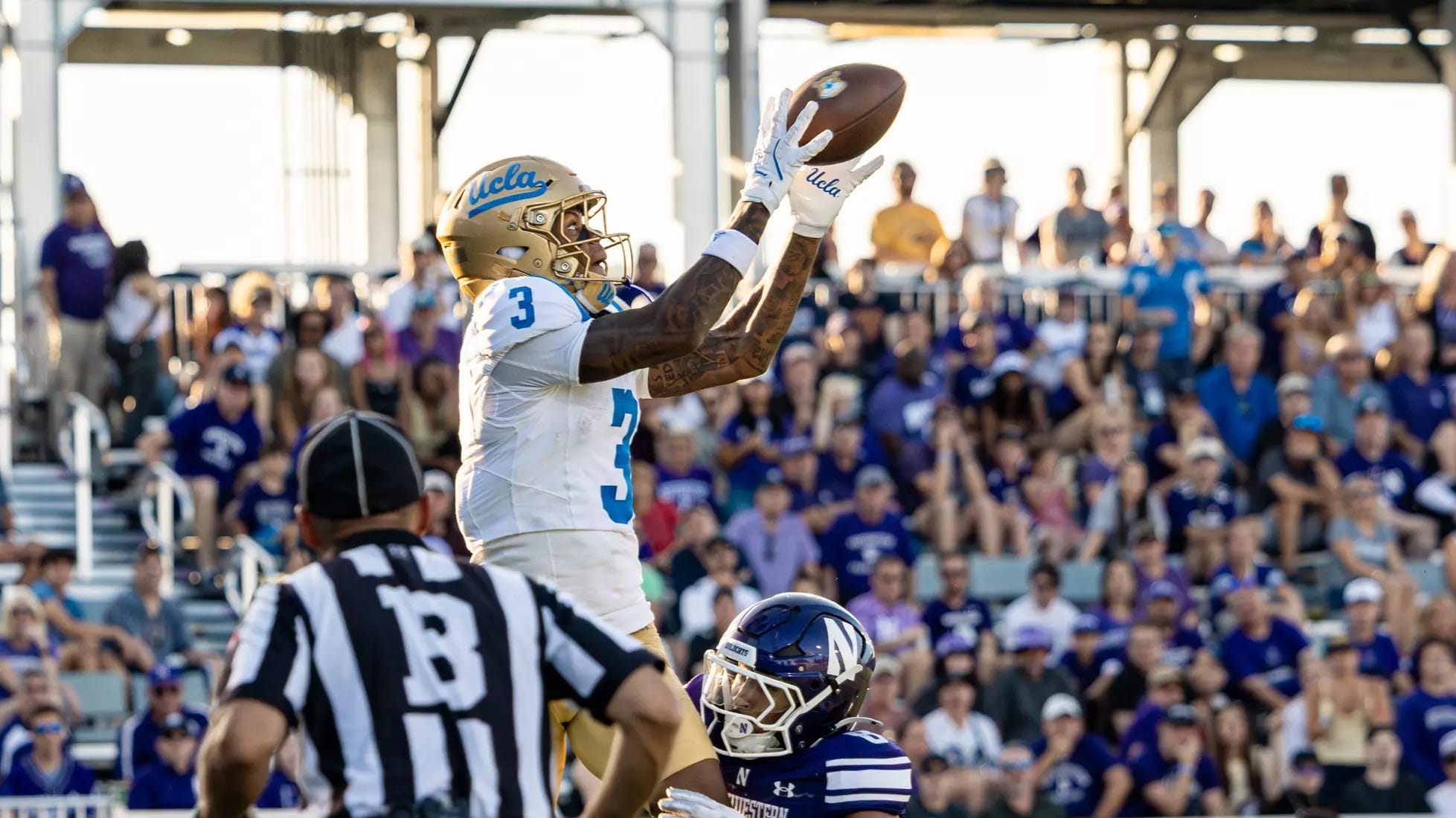
Gilmer — a former top 250 recruit in the 2024 class — spent two productive years with the Bruins during a fairly turbulent time for their program and offense. He played a lot as a true freshman, with 31 catches for 345 yards and two touchdowns, one of which came on a shot play in UCLA’s upset of Nebraska. He was UCLA’s leading receiver last season, going over 500 yards, and entered the portal after the year as UCLA replaced its whole coaching staff.
Gilmer’s reputation is as a deep threat, though he also was UCLA’s No. 1 wideout and X receiver. He played almost exclusively on the outside of the formation and was the isolated backside wideout frequently when UCLA went into trips formations and ran a lot of those backside routes: verticals, 10- to 12-yard digs, curls, comebacks, and quick slants. He started in NU’s spring game and had several explosive reps against the No. 1 defense.
To get a gauge of whether Gilmer can serve as a downfield threat, I watched and charted six of Gilmer’s games from last season, against Utah, Northwestern, Penn State, Indiana, Ohio State, Washington, and USC, which was well over 200 gradable snaps/routes.
Let’s get into what his strengths and weaknesses are and whether he can serve a deep threat for NU this season. Gilmer is wearing No. 3 in these videos, but I’ll also point out where he is in parentheses before the video if it’s not clear.
STRENGTHS
Short-Area Foot Quickness
I came into Gilmer’s tape expecting to mostly see an explosive vertical threat, but I came away thinking his best skill is actually his short-area foot movement and agility — specifically his foot quickness to defeat press coverage at the line of scrimmage or on short-angle routes like slants or quick ins. Most of his best reps overall came when he won a route early off the line with quick feet (solo receiver toward bottom of screen running a slant):
Gilmer’s movements off the line are compact, deliberate, and quick and explosive enough to threaten defensive backs into responding in an initial direction, allowing Gilmer to break away from the defender’s leverage and generate separation. He has a great feel for when he gets a defender leaning away from him and has good foot speed to fire out of the break away from the defender and maintain his balance and posture to get into the route. In the clip above, his initial explosive steps off the line get the corner going backwards expecting a vertical stem, and then he snaps off the slant explosively and gets a huge amount of separation for the QB to throw the slant into.
The main area where Gilmer’s foot quickness manifests is when pressed at the line of scrimmage. Gilmer does not attempt to defeat press often with hand combat, almost entirely relying on his choppy feet to get defenders going one way so he can get off the line in the other. His footwork was often so fast the corner wasn’t able to get a hand or punch on him. He most commonly relied on a “foot fire” technique — short, choppy steps back and forth before exploding into the stem of the route (receiver to top of screen in both clips):
But I also informally counted Gilmer using at least four other press-beating techniques, including a hard jab step to one side with a break in the other direction (isolated receiver to bottom of screen):
a speed release based purely on getting to the shoulder of the corner as fast as possible (isolated receiver to bottom of screen):
and a “hesitation step” release with Gilmer slow playing the corner into a backpedal before tempoing into his stem (isolated receiver at the bottom of screen):
Gilmer’s short-area foot quickness also made him useful on sharp in-cuts off the line, like slants, drags, or quick ins. His explosive foot movement off the ball allowed him to sell these routes for a step upfield — getting the corner to backpedal or stay static for fear of being beaten on a vertical stem — before snapping the route off inside to generate a ton of separation:
NU ran a decent amount of these clearout slants and ins last year out of stacks and bunches on third downs — frequently with Key running the primary in-cut route — and Gilmer is just way more explosive at hitting these types of routes than Key was and will be immediately useful there. This could be his best skill as a receiver.
Multi-break routes like insert corners or slant-and-gos also let him put people in a blender (bottom of screen in first video and top of screen in second video):
Above is a post-and-go with Gilmer cutting in-and-out of a post and then back to the sideline that really shows off his foot quickness in relation to the secondary. The second video shows him making quick cuts on a corner route with an inside stem.
Keep reading with a 7-day free trial
Subscribe to Black 41 Flash Reverse to keep reading this post and get 7 days of free access to the full post archives.