

Some Unstructured Spring Game Observations
What can we learn about Nebraska's scheme and personnel from a glorified practice? A little, at least!

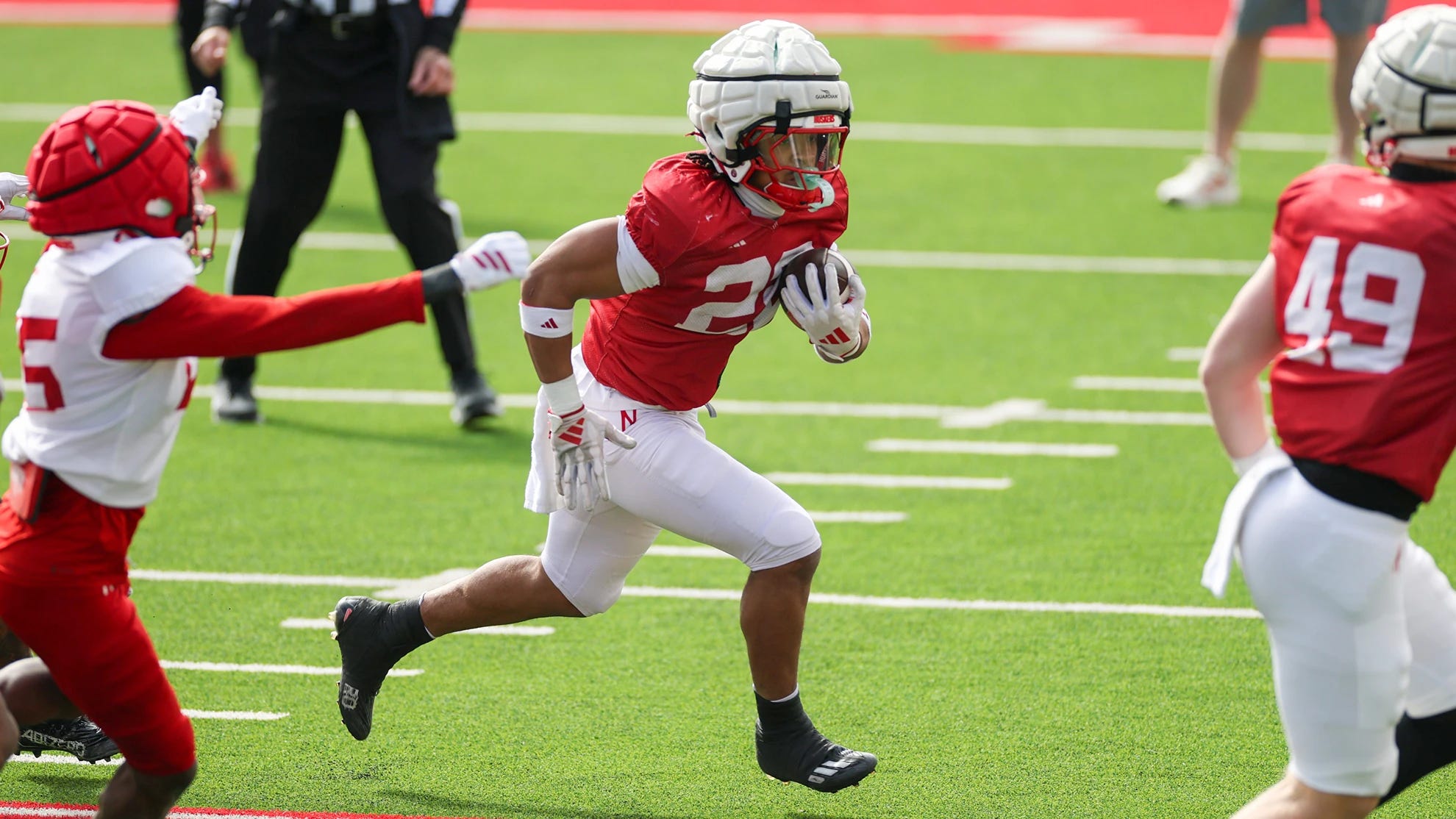
Generally, I think it’s a bit difficult to use the spring game to draw any major conclusions about a college football team or its players. That’s mostly because it’s a glorified practice, one session out of 15 total that, for all we know, could have been opposite of the 14 other practices the public wasn’t allowed to see. Spring games happen with no game-planning for the opponent and use only base plays and concepts on offense and defense. They’re six months away from the actual kickoffs that matter, with a lot of player development work happening in the interim. And a lot of the snaps happen against second- and third-team players who probably won’t be (figuratively) anywhere near the field for meaningful fall Saturdays.
Still, I think the skepticism of spring games has gone a little too far from fans and media. You can tell some important stuff from them, namely:
what a team thinks its base concepts are on both sides of the ball,
what the team has been practicing the most during the spring session,
what positions players are playing, and
general physical talent of the roster or certain players who haven’t seen the field in games or are new to the program.
If a spring game isn’t necessarily a meaningful, full football game … it’s still reps of live football, and that can still tell us something about the team.
In that spirit, I had a few observations from a couple watches that might fit into topics I’ve already discussed this offseason or will discuss this summer. I didn’t hardcore chart the game or anything, so these aren’t scientific hard data, rather just things I noticed and thought might have some intrigue to readers. So take these more on the personal opinion side than provable analysis side.
Back-Seven Position Assignments In Aurich’s Defense:
Before getting into this one, you’ll probably want to first read my posts detailing and charting new DC Rob Aurich’s defense and its basic functionality:
Aurich’s scheme has several specialized positions at the second and third levels, namely a nickel, a boundary linebacker, a middle linebacker, a field safety, and a boundary safety. The spring game gave us an update on who may be fitting in where at those spots in the first few units.
Nickel
In my post about his defense, I talked a bit about how the “nickel” spot for Aurich is really just a linebacker who plays to the “field” side of the formation (the wide side of the field with the ball on the hash), different from Nebraska’s previous usage of the nickel as a pass-game adjuster. The nickel spot in this new defense will likely be the hardest job, as this has to be a player who can legitimately fit the run as an OLB would from the overhang while still being able to cover receivers like a corner would. I wondered who on the roster would be a good fit at the nickel, as NU really hadn’t operated with a true hybrid LB/DB nickel in its five-DB packages very often recently.
In the spring game, it appeared the answer was to move outside corner Donovan Jones inside to the nickel spot. Mario Buford ran at the nickel with the no. 2 defense, and Bralen Prude with the no. 3s.
Moving Jones inside makes some sense; he was pretty clearly NU’s most physical corner last year and best tackler at the spot on tape, skills that will help at a de-facto OLB position. But it’s also a bit surprising, as last season NU moved Ceyair Wright inside after Malcolm Hartzog’s injury in non-conference play, putting Jones in the game only as an outside corner. If the staff felt confident with Jones as a slot defender then, it would have made more sense to insert Jones at the nickel after Hartzog’s injury and keep Wright outside. They instead felt more comfortable with Jones outside and Wright sliding inside. But clearly something in the last several months has changed to give them more confidence with Jones playing in the slot.
It’s also a bit surprising because Jones is a taller corner, which isn’t usually a fit at the nickel. Playing pass coverage from the slot requires defending routes that can break three ways (to the sideline, to the field, and vertically), whereas playing outside only requires defending routes that can break two ways (toward the field and vertically, with the sideline preventing true outside-breaking routes).1 Defending three ways usually requires better change of direction laterally (more agility), something taller and more high-cut corners are less apt to be good at because it’s harder for taller players to sink their hips. Jones is certainly a good athlete with good speed, but he seems to be better running in a straight line as a sprinter and may struggle with more of the change-of-direction aspects of the position. But we really haven’t seen him play in the slot, either, so that could be unfounded.
Boundary Outside Linebacker
Opposite the nickel, Aurich’s defense aligns one of its two true linebackers as an outside linebacker to the “boundary” (the short side of the field with the ball on the hash). This player is essentially a standard 4-3 outside ‘backer.
San Diego State transfer Owen Chambliss played the BOLB in the Aztecs’ defense and was unsurprisingly starting for NU in the spot in the spring game. I caught a general sense of him when watching the SDSU defense for the 4-2-5 project; Chambliss is a good tackling, high-floor player from the spot. 2
The BOLB was more interesting for who was backing up Chambliss. Pierce Mooberry ran in the spot with the No. 2s, and Iowa State transfer Will Hawthorne played there with the No. 3s. Mooberry was probably the least-heralded recruit of NU’s 2025 linebacker class but appears to be the top backup at the BOLB spot, though there is a whole summer of development to go that could change that.
Dawson Merritt, who missed the spring, also would make sense in the boundary linebacker spot.
Middle Linebacker
Aurich plays with a true Mike linebacker aligned over or just off the A gaps. Vincent Shavers played that spot during the spring game.
I had wondered where Shavers would fit in. He was clearly Nebraska’s best overall linebacker on tape last year when healthy and has an athletic upside you almost have to get on the field, but his smaller body type and skillset probably lean more toward playing outside linebacker in more space than playing true inside linebacker, where he’s more likely to face downhill offensive linemen climbing to him off doubles. But with Chambliss transferring in presumably to start, Shavers was going to either have to move inside or be a rotation player behind Chambliss, which would have been a waste.
With Shavers starting at Mike in the spring game, it appears that the staff feels getting Shavers on the field is more important than a possibly tricky positional fit. Shavers from the spot is going to need to improve his play at taking on blocks. Shavers is most effective as a run defender by making blockers miss him in space through his athleticism and angle destruction, but in the more condensed, brawling area in the spine of the formation, that block-avoidance is going to be a lot more difficult. He’s going to have to improve his ability to “destruct” blocks after he’s engaged, especially with so many college football turning to Duo-based runs schemes with multiple double-and-climb actions. There will be some benefits to putting Shavers at Mike; Shavers is an explosive player moving toward the line, which will hopefully allow him to beat blockers to spots and cause havoc in the middle of the formation, and he’ll also similarly be a threat as an A-gap blitzer. And his coverage responsibilities at the Mike will likely be a bit easier for him to handle.
Behind Shavers at the Mike were Derek Wacker and Christian Jones.
Field and Boundary Safety
One of Aurich’s safeties aligns to the wide side of the field with the ball on the hash (the “field safety” or “FS”), and the other aligns to the short side of the field with the ball on the hash (the “boundary safety” or “BS”). In a “split-safety” defense, as Aurich’s is classified, the safeties are fairly interchangeable because they’re often both aligned two-high, but the FS is more likely to play over the top in single-high coverages and the BS down as the rotator (though there are coverages where that is flipped, too). With the field safety the more over-the-top role meant to put a lid on the offensive passing concept, you’re more likely to see faster, rangier, center-field types play at FS in this defense, with more physical tacklers and quasi-linebacker types playing the boundary safety spot.
The starting field safety in the spring game was Jamir Conn, with Justin Rhett and Jasin Shiggs coming in with the twos and threes.
The starting boundary safety in the spring game was San Diego State transfer Dwayne McDougle III, with Caleb Benning behind him.
Conn had gotten some buzz at possibly being the nickel after bowl practices but seems to be now playing over the top. Conn’s a pretty good athlete, so that makes sense. And at just 180 pounds, it would have be tough for him to survive in a linebacker-esque nickel role unless he was just an elite-tier block avoider. McDougle played the boundary safety for the SDSU defense, so him being there wasn’t a surprise. Benning was also floated as a nickel candidate, but it looks like he’s playing on the back end, too, which he did in the bowl game.
What remains to be seen is where Rex Guthrie, last year’s starter at safety who missed the spring, slots in. Guthrie played about 56% of his snaps deep last year and about 44% in the box per my charting and was also a key rotator in the defense, behind only DeShon Singleton in rotation rate. So I’d imagine that would make him more of a fit at BS, though he could do both, since the roles are fairly interchangeable.
Other Positions
The other spots in Aurich’s D are less specialized, but for anyone wanting to know who was where:
Defensive tackle:
Starters: Riley Van Poppell, Jahsear Whittington
Second team: Owen Stoudemire, Sua Lefotu
Third team/reserve: Gabe Moore, David Hoffken, Malcolm Simpson, Tyson Terry
Edge:
Starters: Kade Pietrzak, Cam Lenhardt
Second team: Williams Nwaneri, Mason Goldman
Third team/reserve: Jordan Ochoa, Willis McGahee IV
Outside Corner:
Starters: Andrew Marshall, Jeremiah Charles
Second team: Victor Evans, Danny Odem III
Third team/reserve: Amare Sanders
Third Linebacker (In 4-3 defense with no nickel)
Starter: Dylan Rogers
Second team: Vincent Genatone
Still No Dropback Passing
I talked quite a bit last season about how Nebraska’s offense began phasing out true dropback passing concepts as conference play went on when it became clear the tackles weren’t capable in pass pro, instead relying more heavily on run-pass option concepts (RPOs) and hard-fake play-action passes (both of which have the offensive line run blocking); quick-game passes (which are “catch-and-throw”-style concepts that don’t require long counts or pass sets for protection), and screens (which also do not require true pass protection, with the play-side offensive line imitating a pass set before releasing down the field). That process accelerated after the Michigan game, but those four concepts came to constitute pretty much all of NU’s passing attempts when TJ Lateef came in for the final three regular season contests. In Lateef’s three regular season starts, true handoffs, RPOs, quick-game and play-action passes, and screens constituted 144 of Nebraska’s 170 snaps against UCLA, Penn State, and Iowa (84.7%). Lateef ran just 26 true dropback passes in three games. And two of those games found Nebraska down multiple scores in the second half, meaning an offense would be passing at a higher rate than normal. This was not an offense that was going to run true dropback passing over that final stretch unless it was down big, and even then, still not very often.
Keep reading with a 7-day free trial
Subscribe to Black 41 Flash Reverse to keep reading this post and get 7 days of free access to the full post archives.