

TENDENCIES: 2025 Defense
All of the data I tracked on how Nebraska’s defense lined up and operated — and how successful all of those elements were

Welcome back!
A lot is happening/has happened with Husker football since I last posted, but I’m still wrapping up my analysis of the 2025 season with my yearly deep dive into the Huskers’ defensive tendencies.
This will be similar to the offensive version of this post, which is linked below and free for everyone to read:
This write-up is already obscenely long, so I’m not going to get into the methodology or explain the charts again; for any questions or new readers, please consult the intro of the offensive tendencies post above for a more in-depth explanation of what these numbers mean and how to read/interpret these charts.
When looking at the defensive numbers that we’ll get into in this post, a clear pattern emerges to me: NU, under new coordinator John Butler, played as aggressive a defensive philosophy as it had in recent memory for the first 10 games of the 2025 season. From the Cincinnati through UCLA games, NU’s stunt rate, secondary rotation and movement rate, blitz rate, and man coverage rate on key downs were all elevated beyond what we’d seen from previous coordinator Tony White. NU’s defense in that stretch had some ugly moments and had been vulnerable to big plays, but it had hung around in the top 40 of most statistical services. Not perfect or great, and certainly with its liabilities, but servicable. Considering the personnel deficiencies up front for this unit, through 10 games, that aggressiveness gambit had paid off.
But following the post-UCLA bye week, almost all of those aggressive tendencies vanished, with NU electing to play heavier personnel more straight up and conventional. Nebraska almost entirely stops stunting up front, plays far less often with three safeties on the field, and keeps its secondary far more static than it had to that point in the season. The staff — or someone on the staff — elected to throttle back the “gimmicky” stuff with the defense for the final two games and try to play with Penn State and Iowa, to fairly disastrous results.
This post will get into those numbers individually and offer more detailed explanations.
I changed up my defensive charting pretty significantly this year, so a lot of the comparisons to past years may be incomplete. If you see blank spaces or “N/A”s, that’s what that means. The individual performance metrics I get into at the end are entirely new for this year, so no comparison at all there.
The sections in this post are:
PERFORMANCE
General Performance
Situational Performance
PERSONNEL
General Personnel
Line Personnel
OPPONENT DATA
Opponent Play Type
Opponent Personnel
FRONTS/BOXES/SHELLS
Fronts
Shells
Box Counts
Pressure Packages
Front Shifts
SAFETIES AND COVERAGE ROTATION
Pre-Snap and Post-Snap Safety Shells
Safety Alignments
Rotation Frequency and Type
Rotation Player
RUSH DATA
General Rush
Stunts and Twists
BLITZES/PRESSURES
General Blitz and Pressure Data
Blitz Locations
Sim Pressures
Blitzer
COVERAGE
Coverages and Coverage Distribution
Press Coverage
INDIVIDUAL PLAYER PERFORMANCE
Run Fits
Tackling
Pass Rush
Coverage
Let’s get started!
PERFORMANCE
General Performance
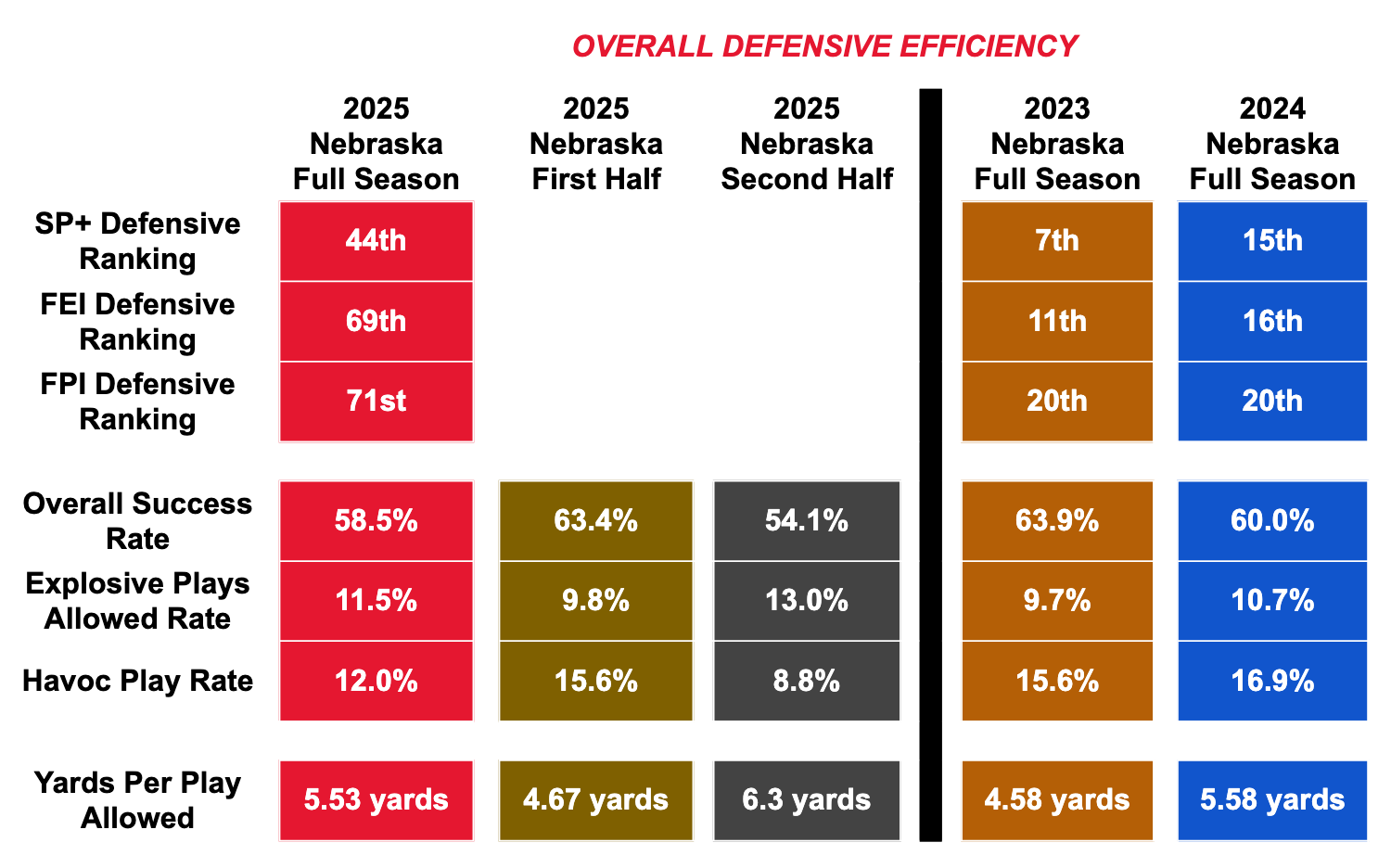
Surprising no one who watched the games, the defense fell off considerably per the holistic predictive metrics in Matt Rhule’s third season, though how drastically depends on which service you want to rely on. The unit that in Rhule’s first two seasons finished top 20 or better nationally in each of the three services I track dropped to a still-decent 44th nationally in SP+’s schedule-adjusted defensive ranking but tumbled even further to 69th in FEI defensive ranking and 71st in FPI. All of Nebraska’s underlying stats worsened from 2024, except it gave up slightly fewer yards per play in 2025 than in 2024.
It’s worth noting, though, that the 2025 unit was virtually identical with the 2023 and 2024 defensive performances through the first six games in the underlying stats. That may be surprising considering the amount of big plays we saw the Blackshirts give up in games against Cincinnati and Michigan in the first half of the year, but the actual statistical performance isolated from the optics was largely the same: Through the first six games, the 2025 defense compared to 2024 defense was similar in success rate (63.4% to 63.9% in 2023 and 60.0% in 2024), explosive plays allowed (9.8% to 9.7% in 2023 and 10.7% in 2024), havoc plays created (15.6% to 15.6% in 2023 and 16.9% in 2024), and yards per play allowed (4.67 to 4.58 in 2023 and 5.58 in 2024). I think it’s fair to say the 2025 defense’s bad plays were worse than either of the previous two year’s bad plays, which made it feel worse, but from a holistic perspective the overall production ended up largely the same. Those first six games also featured dominant performances by the D against poor offenses from Akron and Houston Christian, so schedule played some role in it, too.
But the defensive performance changed big time in the second half of the season. The success rate fell nearly 10 percentage points and the yards per play allowed increased by almost two full yards, while the amount of explosive plays allowed skyrocketed over three percentage points to 13.0% and the amount of havoc plays NU generated on defense plummeted from 15.6% of snaps to 8.8% of snaps.
And that sample can be isolated to a very poor final four games. Despite the loss and one long run allowed, NU’s defense had a 61% success rate against Minnesota and 7.41% explosive play rate allowed, and it topped a 60% on success rate against Northwestern with a 10% explosive play rate allowed. But in the final four games — against USC, UCLA, Penn State, and Iowa — the defense had success rates of 51%, 50%, 47%, and 51% and explosive play allowed rates of 18.9%, 11.4%, 18.8%, and 11.6%, respectively.
That paints a picture, then, of a defense that was largely in line with what we’d come to expect from Rhule’s units in the first eight games (if slightly worse), followed by what was one of the worst defensive performances in the program’s recent memory in the final four regular season games, with insane amounts of explosive plays allowed.
I think it’s important when discussing the defense to discuss and diagnose this dichotomy; the defense wasn’t bad for the full season, but when it got bad at the end, it got really bad.
Situational Performance
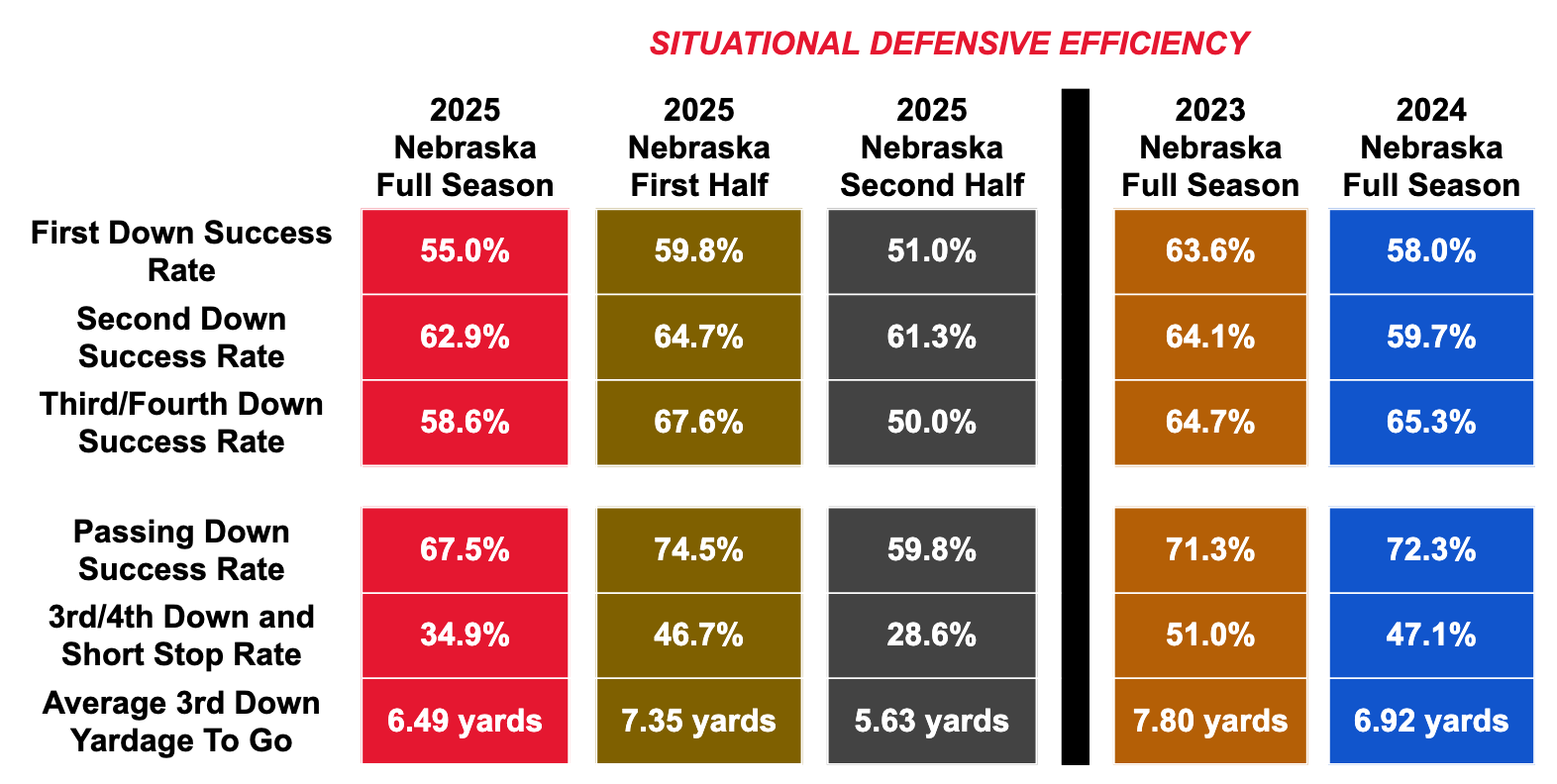
On isolated down defense, NU got slightly worse in efficiency on first and second downs but significantly worse at third- and fourth-down defense, especially in the second half of the season. NU stopped opponents on 58.6% of third and fourth down attempts, down 6 percentage points from 2023 and 7 percentage points from 2024. But in 2025’s first six games, the third- and fourth-down success rate was actually higher than the previous two seasons, at 67.6%. The drop in third- and fourth down defense was entirely caused by the second half of the year, when that rate fell all the way to 50%.
The money-down struggles were at least partially driven by the average length opponents needed to convert on third downs falling from 7.35 yards in the first six games (in line with the 2023 and 2024 Blackshirt performances) to 5.63 yards, a drop of nearly 2 full yards. NU also got also got significantly worse at stopping opponents in short yardage in the back half of the year, with the rate of stops in third- and fourth-downs of 3 yards or shorter going from 46.7% in the first half or the season (similar to 2024) to 28.6% in those final six games. So, in the second half of the year, NU let opponents get in shorter third- and fourth-down situations and got worse at stopping those short-yardage situations. Not a recipe for success!
The defense also fell off in the final six when it did get teams in long yardage. In the first six games, Nebraska’s defense had its best performance in Rhule’s tenure on passing downs (second downs of 8 yards or longer and third and fourth downs of 5 yards or longer), at a blistering 74.5% success rate. That’s a real testament to the quality of the secondary; with Nebraska having little individual pass rush success and blitzing more frequently to cover for that lack of isolated rush, the secondary was put in far more one-on-one or down-advantage situations and still delivered improved long-yardage performance from two top 20 defenses in previous years. The secondary’s play deserved every bit of praise it got in the first stanza of the season.
But that passing-down performance also majorly dropped in the back half of the season, falling over 15 percentage points to a 59.8% success rate. NU faced a top-five passing offense in USC in that stretch but played well against the Trojans; the poor play largely came against NU’s easiest passing competition. In games against Minnesota, UCLA, Penn State, and Iowa — none of which had a top-100 passing offense nationally — NU’s passing-down success rates were 63.6%, 45.5%, 58.8%, and 66.7%. That was partially due to Nebraska having to allocate more resources toward the front-seven to stop those teams’ very solid rushing attacks, and most of UCLA’s good plays on passing downs were scrambles, but the long-yardage performance, statistically, got much worse in those final six games, most of which were against atrocious passing teams. That was at least as big of a deal as the run defense falling off in the late defensive struggles.
PERSONNEL
General Personnel

1 NU stayed in its “base” personnel — base nickel, with five defensive backs on the field — at about the same rate as last year, but greatly upped its usage of “dime” personnel, when it brought a sixth defensive back on the field. Previous DC Tony White had sparingly used dime personnel, with zero snaps of it in 2023 and just 1.5% usage in 2024. But Butler turned to dime looks frequently in passing situations, on over 12.4% of Nebraska’s overall defensive snaps. When in dime, Nebraska would take a linebacker off the field and move DeShon Singleton into the box as a de-facto LB, bringing on an extra DB. Before Malcolm Hartzog Jr.’s injury, the extra dime DB was Donovan Jones, with Ceyair Wright moving to the slot. After Hartzog’s injury and with Jones playing full-time at outside corner and Wright full-time in the slot, the dime player was at first Rex Guthrie and then later became Marques Buford Jr. after Guthrie became a starter. Nebraska had a 67% success rate out of dime this year, over 10% points higher than its success rate out of base personnel. There’s some slight noise there, as the situations in which dime was deployed typically be long yardage and more advantageous situations to the defense, so you’d expect them to be successful more often. But that still speaks to NU’s defensive back room being the best grouping of players on the defense.
Also of note here is how often Nebraska deployed its four defensive back look — what teams would traditionally call “base,” trading one of its five standard DBs in the 3-3-5 for an extra linebacker — essentially a standard 4-3 defense. NU only used this 4-3 look in 2024 for the game against Iowa, when it played all but a handful of its snaps out of the 4-3. Nebraska used the 4-3 some early in 2025, with the look comprising 14% of snaps in the first half of the season but almost all of that usage coming in the Michigan and Michigan State games. That 4-3 look had a very good 67.4% success rate in the first six games. But in the back half of the year, Nebraska deployed this heavier personnel on almost a quarter of its total snaps. It played over half of its snaps against Penn State and over 30% of its snaps against Iowa in this 4-3. The success rate fell to just 50% — worse than its base defense. This is one of the main data points supporting that in the back half of the season — and specifically in the final two games and bowl — there was a clear shift in trying to stop the run from using chaotic looks out of the 3-3-5 and more onto just putting heavier bodies on the field with simplified schemes — to poor results.
Keep reading with a 7-day free trial
Subscribe to Black 41 Flash Reverse to keep reading this post and get 7 days of free access to the full post archives.