

The 4-2-5: Part One
Big-picture takeaways after charting out Rob Aurich’s defensive scheme

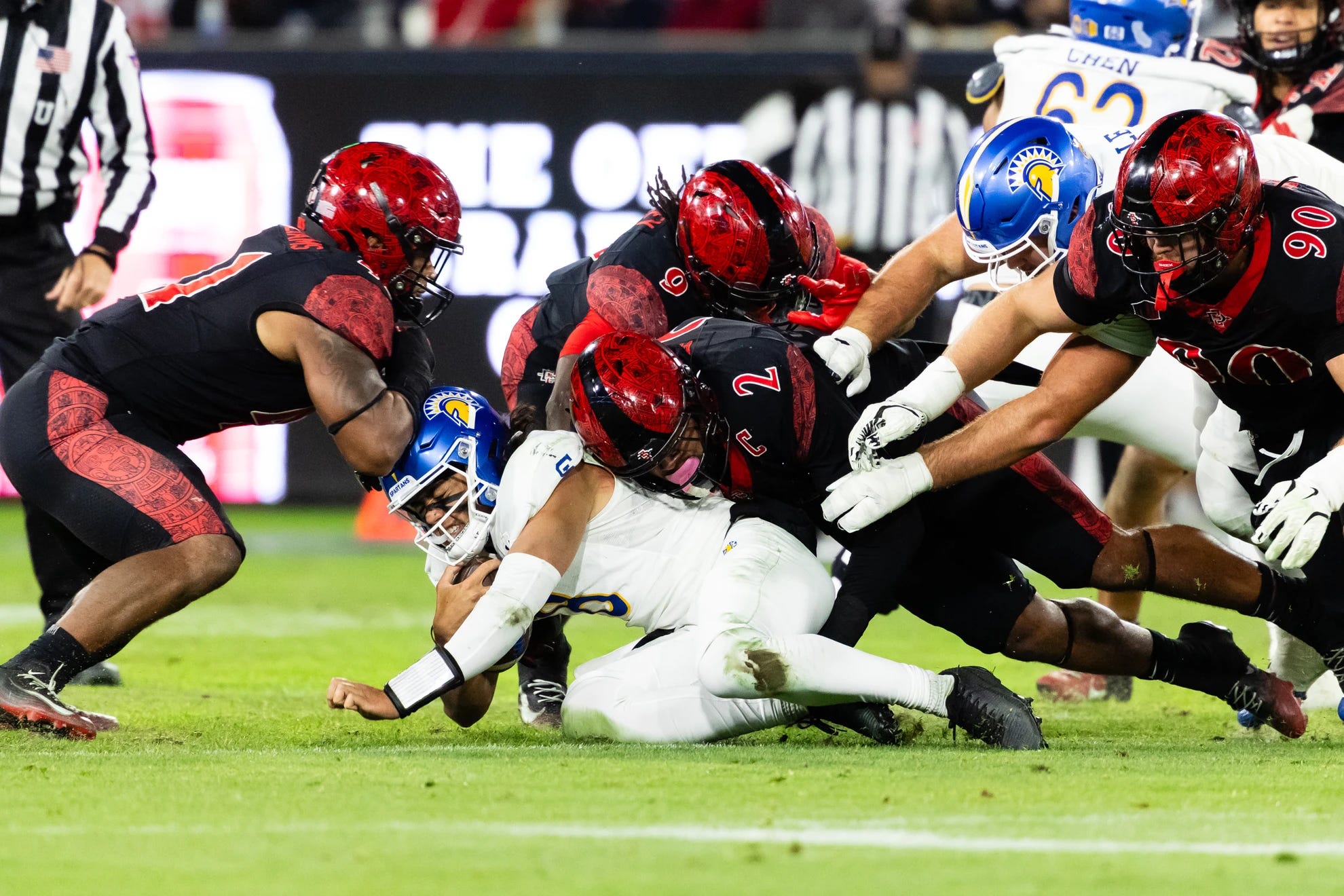
By my recollection, Nebraska has never “officially” run a 4-2-5 defense as its declared identity, yet the program has spent quite a bit of time in its recent history operating out of similar schemes.
Bo Pelini officially ran a 4-3 base, but he often put a safety at his Will linebacker spot — and frequently also even removed a second linebacker for a sixth DB in his early years, when he had dominant four-player lines able to stuff the run. Scott Frost-era defensive coordinator Erik Chinander came from a 3-4 background but spent the vast majority of his time at Nebraska — 72.1% of snaps in that staff’s final season — operating out of a 2-4-5 scheme with two of the outside linebackers at the line of scrimmage, indistinguishable from rush ends, as the sport moved fully moved toward the “base nickel” ethos in the late 2010s. Dyed-in-the-wool 3-3-5 coordinator Tony White spent about 38% and 53% of his snaps in his two respective seasons at Nebraska playing 4-2 Over fronts, and John Butler last season similarly used four-down fronts on about half his plays.
This is not nearly the first time Nebraska has used a defense with four down linemen, two box linebackers, and five defensive backs. It’s done it a lot, in fact.
What is new is that recently hired coordinator Rob Aurich is from the 4-2-5 tree and identifies as a base 4-2-5 coach; Nebraska has run four-down, five-DB looks before, even as base defense, but never in the dedicated 4-2-5 system.
The 4-2-5, like the 3-3-5, has existed since the mid-1980s but really came into the public consciousness in the late 1990s due to the success of Gary Patterson at Texas Christian. Patterson, widely viewed as the progenitor of the scheme, built out parts of the 4-2-5 at UC Davis, Pittsburg State and Utah State in the late ‘80s and early 1990s, then began a run of success with it under Dennis Franchione at New Mexico1 and TCU, where he was later named head coach. Patterson combined the front and schematic elements of the 4-3 with play-style elements of the 3-3-5, specifically the multiplicity and use of smaller, faster guys to get penetration, cause chaos, and funnel the ball to safeties — helping a disadvantaged recruiting school like TCU even the playing field against big-conference offenses.
Patterson was a mainstay in the top-10 defense rankings over two decades with the Horned Frogs. After initially writing it off as a gimmick defense, more and more big programs began migrating to the 4-2-5 (and other base-nickel defenses) as the 11-personnel2/spread/RPO revolution hit college football offenses in the 2010s. The 4-2-5 is probably now the most popular single defense in FBS college football, with disciples like Rob Aurich.
Aurich comes to Nebraska from San Diego State, where he switched the offense-first Aztecs from a 3-3-5 scheme to a 4-2-5 after taking over as DC midway through the 2024 season. Last year, in Aurich’s first full season as coordinator, SDSU improved from 105th in SP+ defensive ranking in 2024 to 28th in 2025, putting up some impressive counting stats, too. Before that, Aurich was the DC at Idaho in 2022 and 2023, where both of his defenses finished in the top 25 of the FCS.
Aurich arrived at Nebraska in December and began installing the defense for bowl practices, so we got a brief preview of his very basic scheme in the game against Utah:
But to see the full package and operation of Aurich’s defense, I went back and watched and charted almost half of SDSU’s snaps from last season to get a sense of how the scheme might operate, what tendencies it play with, and how that scheme might differ from recent five-DB defenses at Nebraska.
As part of an attempt to start making this newsletter a bit more reader-friendly, I’ve broken this project up into three posts instead of my one usual, giant blog. This first post will focus on big-picture takeaways and observations about the defense. The second post will discuss the personnel, fronts, boxes, shells, and rusher totals. The third post will be about the coverages, safety shells and rotations, and blitz and pressure packages and how offenses might attack the D. Both of the next two posts will be out as soon as I can write them but before the spring game on March 28. This post is free, but the final two posts will be behind the paywall. If you want to subscribe to get both of the next two posts delivered to your e-mail inbox, you can enter your information below:
I charted over 300 snaps from five of San Diego State’s 2025 games to get my data. I tried to chart games against a variety of schematic styles and from the beginning and end of the year to give us a fuller picture of how the defense might operate against diverse offensive matchups and how it progressed and adjusted through the season. I also avoided lower-conference or poor-performing teams. The SDSU games I charted were against:
Washington State: SDSU’s second game of the season, a 36-13 loss. Washington State ran a 12-personnel-based,3 power-spread offense out of the pistol primarily utilizing gap-scheme runs, frequently tagged with alert-style RPOs, tied to a play-action shot passing game. A recent Big Ten comp would be what Penn State ran against NU last season. 4
California: SDSU’s third game of the season, a 34-0 win. Cal ran an 11- and 12-personnel fly- and jet-motion-heavy offense out of the pistol and shotgun built around slide RPOs and sprint-out and moving-pocket passing concepts. A recent Big Ten comp would be what we saw Nebraska run last season after Dylan Raiola was injured.
Boise State: SDSU’s 10th game of the season, a 17-7 win. BSU ran a shift-heavy 12- and 13-personnel based offense built around under-center gap-scheme runs and pullers. Boise played its game against SDSU with a backup quarterback who looked not very competent, and the OC wasn’t attempting to pass for a lot of regular play; an example of how the defense might perform in a true bully-ball game. A recent Big Ten comp would be Paul Chryst-era Wisconsin.
San Jose State: SDSU’s 11th game of the season, a 25-3 win. SJSU ran an up-tempo 10- and 11-based passing-heavy shotgun scheme that combines elements of the run-and-shoot and veer-and-shoot with almost no traditional running game and heavy usage of multi-choice RPOs with the QB as a run threat. There’s no good recent Big Ten comp. (and god willing there never will be)
New Mexico: SDSU’s 12th game of the season, a 23-17 loss in double overtime. New Mexico ran an 11- and 12-personnel offense based around a diverse running game tied to Air Raid and flood-style passing concepts. A recent Big Ten comp would be 2024 Ohio State.
I charted every personnel, front, box, shell, pre-snap front shift, rusher, stunt, blitz, blitz gap, blitz strength/weakness, sim or creeper pressure, pressure package, safety alignment, secondary rotation, press, and coverage. Here are the observations from watching all that film:
INDIVIDUAL ELEMENTS
The easiest way to talk about this defense is to break apart the front seven, the back seven and coverages, and the blitz/pressure game separately and then bring them together for some big-picture conclusions.
Front Seven
First, in the front seven, Aurich’s San Diego State defense functioned, to me, like a 4-3 Over scheme that just inserted a safety at one of the outside linebacker spots and kept the responsibilities of the position largely the same.
On the front four, an “Over” front is just a fairly standard four-player front, with one of the defensive tackles aligned in a 3 technique to the offense’s strength and a nose tackle aligned in a 1 technique, with two ends in 5s or slightly wider:
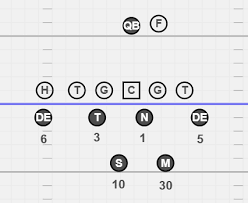
This is probably the most common front in football, and Nebraska has run it plenty in the past few seasons: Last year, NU was in an Over front on almost 35% of its total defensive snaps, even despite its 3-3-5 moniker. Aurich’s defense was much higher basing out of Over fronts, though, at 60% of snaps. SDSU also ran some split fronts, with both tackles over the guards, and some true 4-3 Under fronts. But you should expect NU to play a vast majority of its base down snaps out of an Over front.
Where Aurich’s defense does function very differently than past five-DB schemes Nebraska has run — and more like a “4-3” — is at the second level, with the nickel’s role the key to understanding the differentiation.
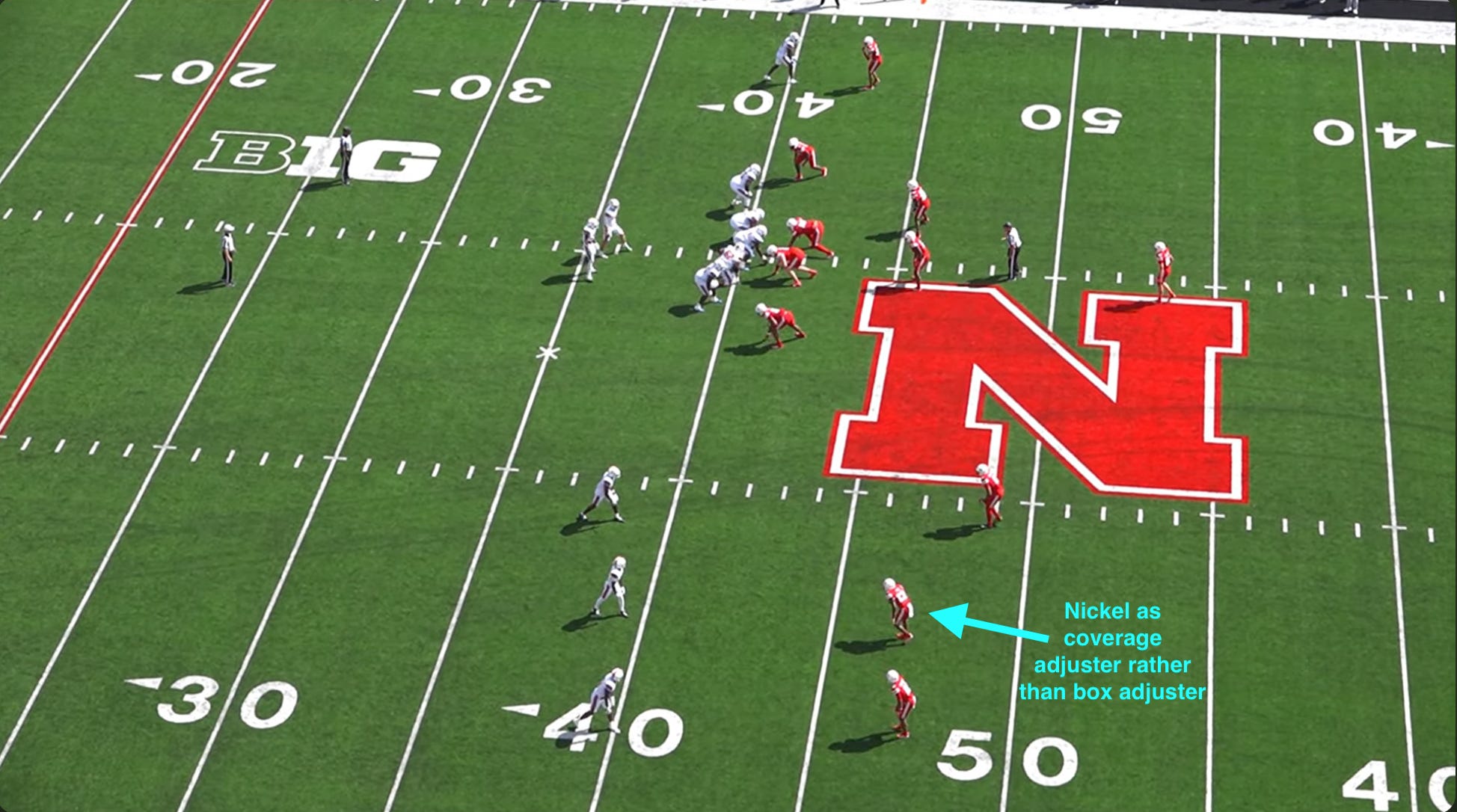
Nebraska’s four-down, five DB looks under Chinander, White, and Butler operated with two defined box linebackers and the “nickel” largely serving as a coverage adjuster/player who mostly aligned to the passing or formation strength (and also functioned as an add-on to the box in certain heavy alignments). Those nickel players under the recent defensive schemes (Cam Taylor-Britt, Malcolm Hartzog Jr., and Ceyair Wright) had run-fit assignments but largely played well away from the box and played over receivers, most often migrating to the trips or quads sides of formations if offenses elected to overload a side. And under White and Butler, the nickels spent time as true third safeties playing deep. The nickels in the White and Butler defenses also were key rotators, often going from the second level to third after the snap — or vice versa — as part of coverage disguises. These are generalizations, and the Chinander, White, and Butler nickels spent plenty of time in the overhang where an outside linebacker would, but the nickel positions in those defenses were generally varied roles whose priority was to help in coverage against slot receivers more than being a consistent overhang player in the run fit. This would be one example from last year:
But Aurich’s defense at San Diego State seemed to treat its nickel the exact same as an outside linebacker in a 4-3 scheme.
The 4-3 — and Aurich’s defense — is much more of a “mirrored” defense, with the left and right side of the formation looking identical when in base down, non-check alignments. Players will slide and adjust based on how the offense aligns, obviously, but if you drew a line down the middle of a 4-3 against a standard 2x2 formation, on each horizontal half of the field, you’d get one defensive tackle, one defensive end, one outside linebacker on the overhang, one safety deep, and one corner wide to each side, with the middle linebacker directly over the center bisecting the alignment. You can see the same principle in Aurich’s scheme; there’s one on each side of the imaginary line:
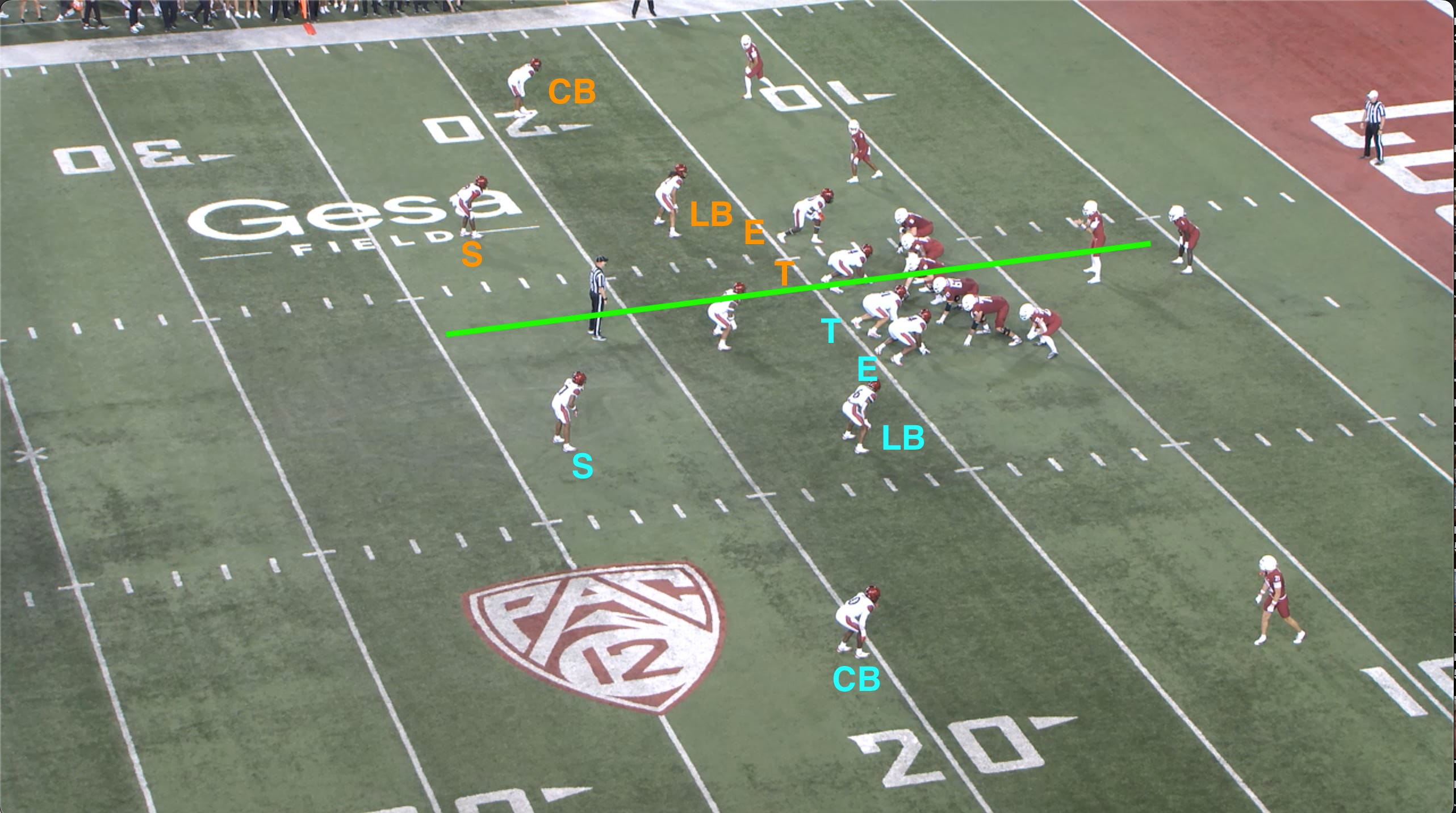
The nickel in Aurich’s scheme is essentially just one of these mirrored outside linebackers in a traditional 4-3 defense:
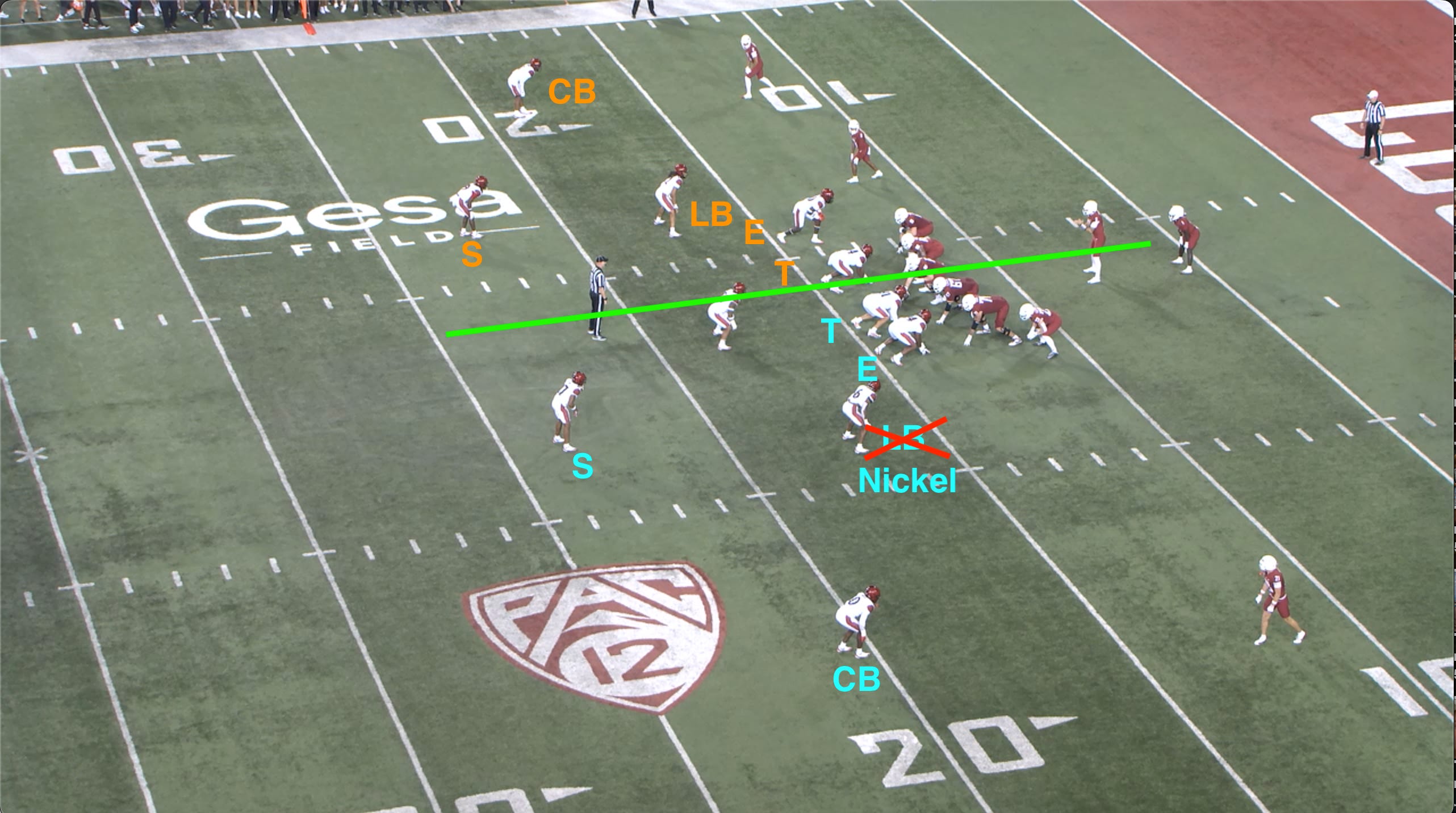
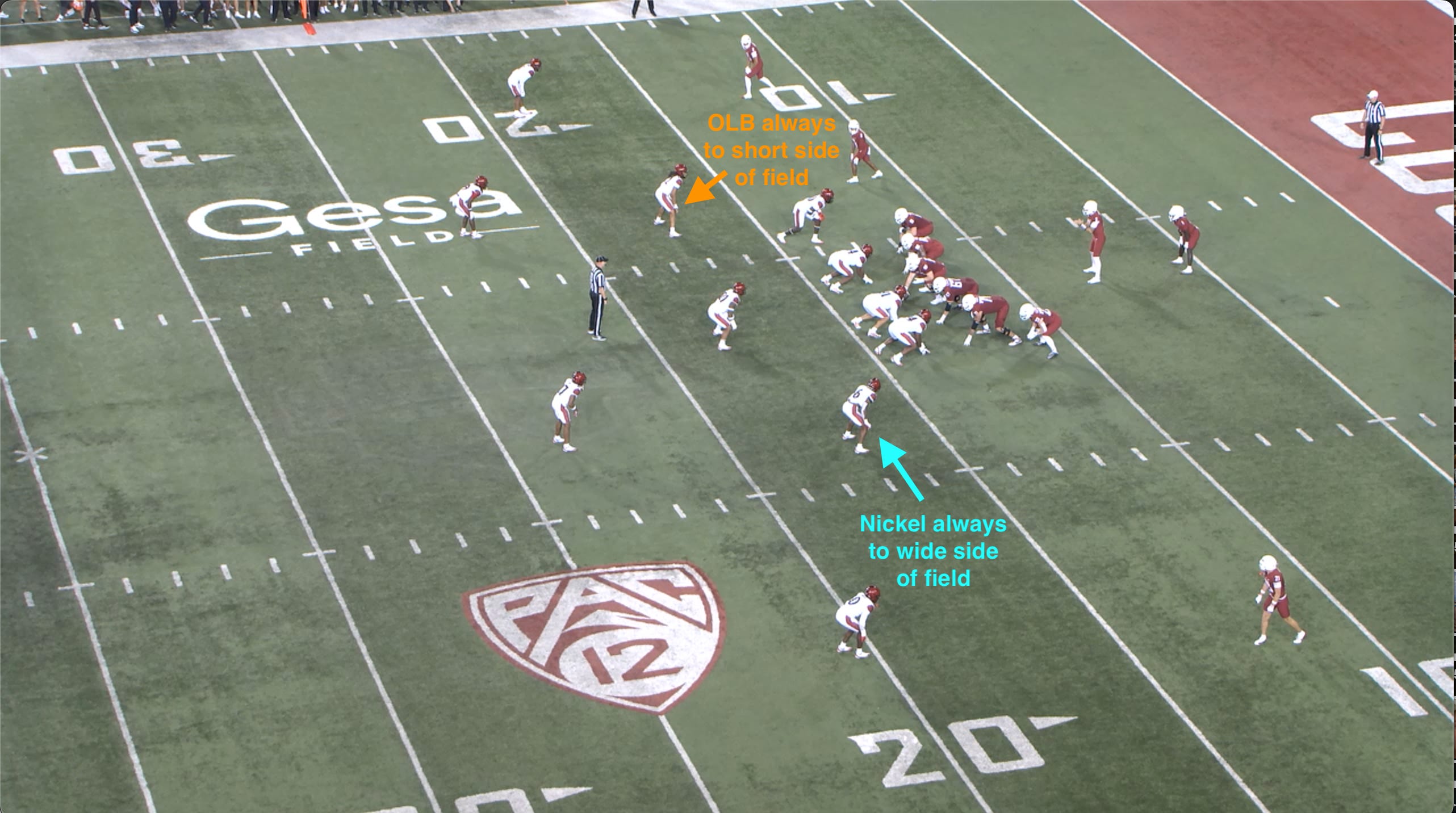
Which side the nickel plays this OLB role on is determined by space on the field. The nickel (almost) always plays this “outside linebacker” spot to the wide side of the field, while one of the actual two linebackers plays the other “outside linebacker” spot to the short side of the field. This creates two mirrored “outside linebacker” alignments, one to the wide side (often called the “field” alignment) with a more athletic safety body, and one to the short side of the field (often called the “boundary”) with the bigger — but less athletic — linebacker body. Nebraska transfer Owen Chambliss was the boundary outside linebacker on the SDSU defense, essentially mirroring the nickel. Here’s what it looks like:
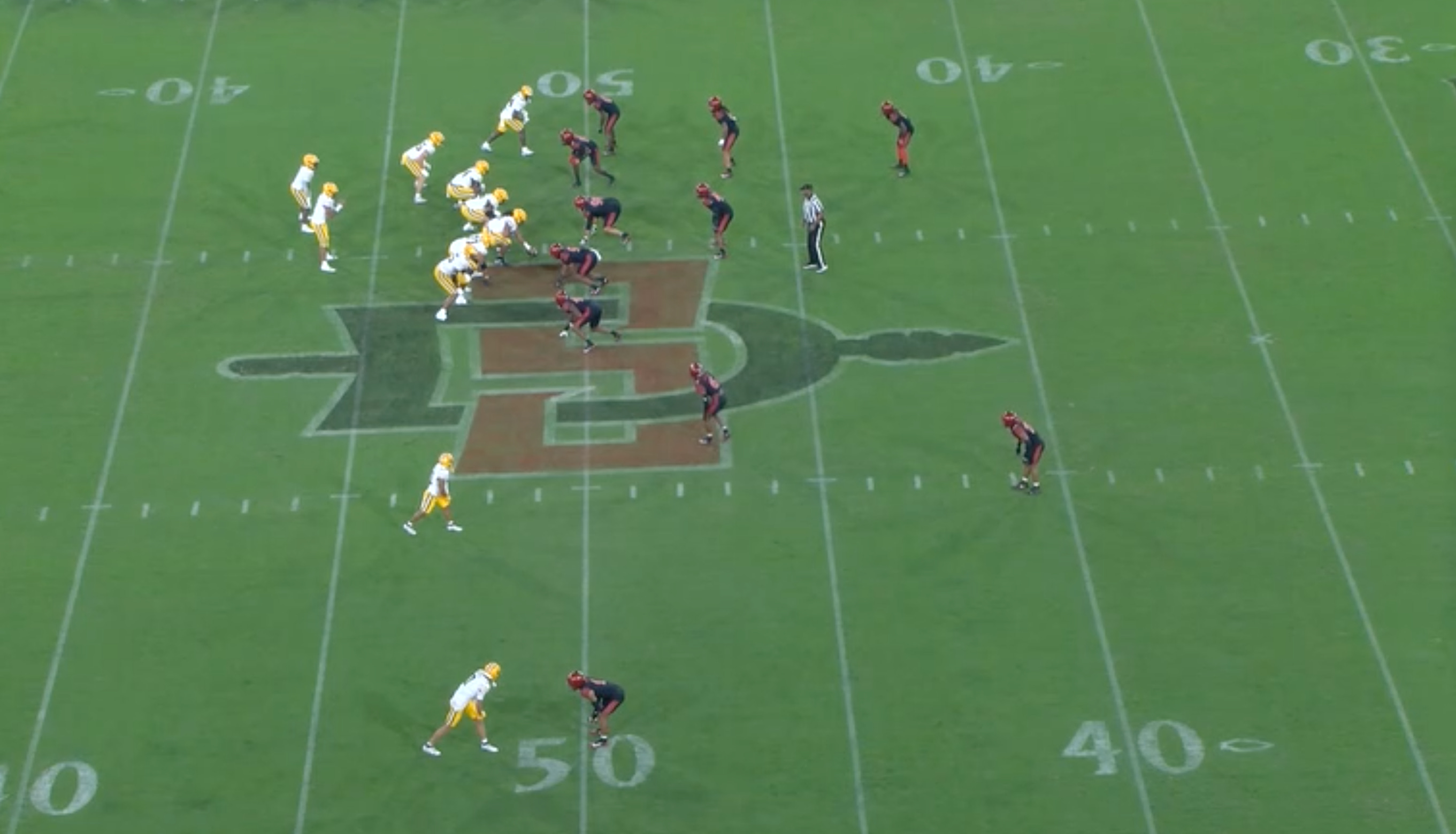
Both the nickel and boundary OLB aligned pre-snap exclusively at the second level on base downs in the overhang position (just outside the tackle box) against spread 2x2 offensive looks, like above, or would move inside the box closer to the tackles if the formation got more condensed:
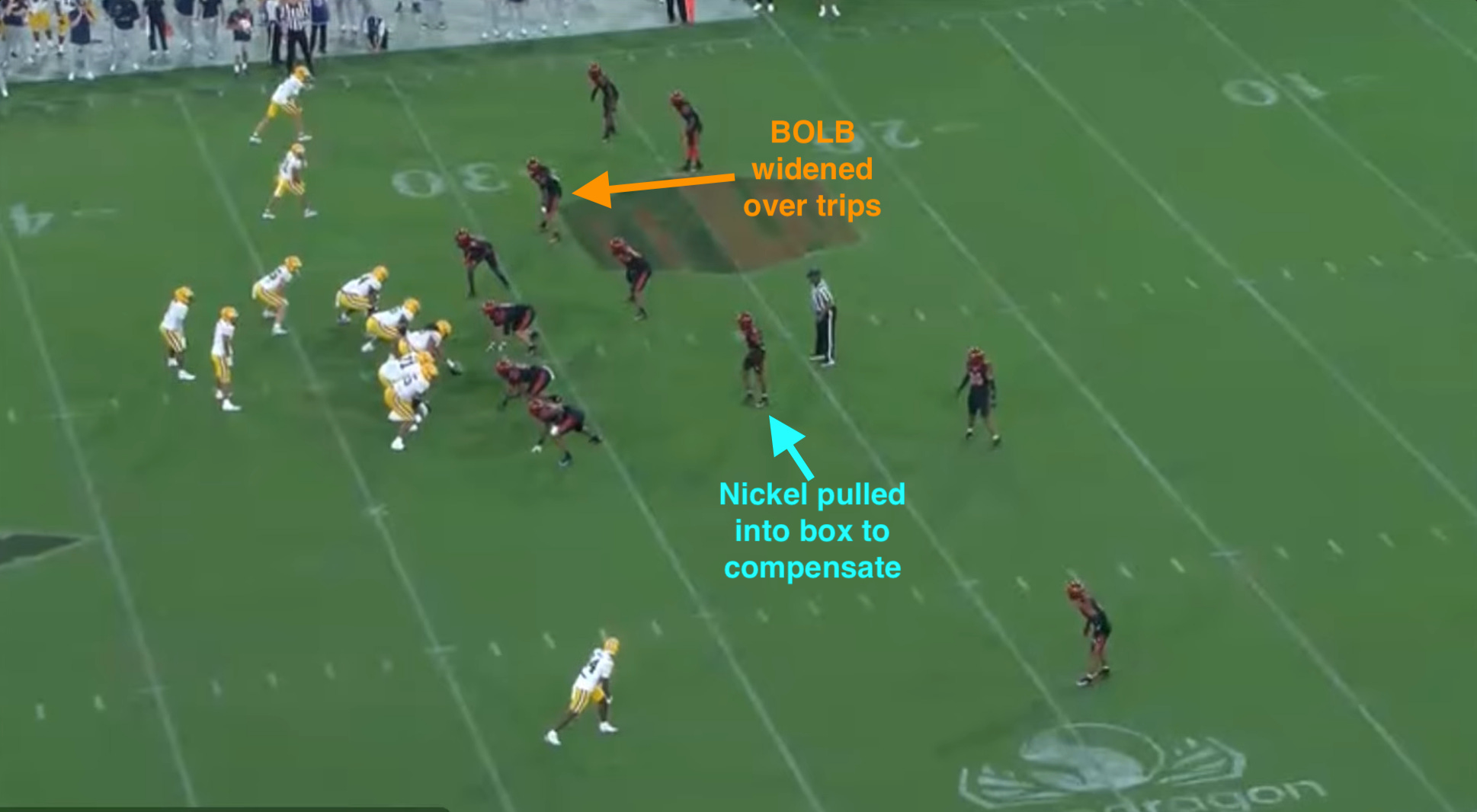
Against trips, the OLB or nickel to the the third receiver’s side would slide out over the receiver (sometimes with the Mike) and the OLB or nickel away from the third receiver would be pulled into the box:
Against quads, with the Mike linebacker also sliding to the passing strength, the backside nickel or boundary outside linebacker would be asked to move in and play the de-facto Mike linebacker spot over the A gaps:
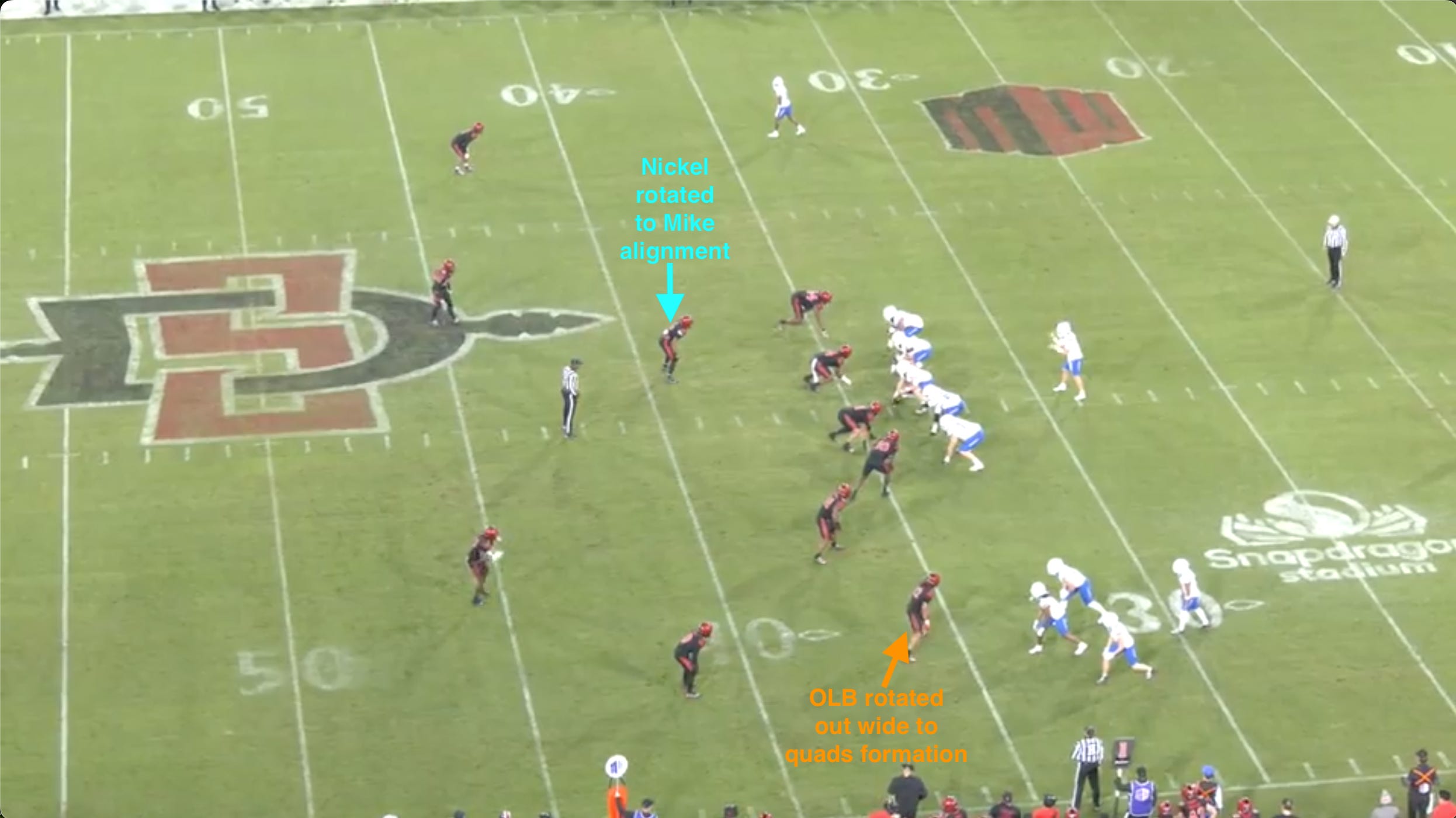
So, despite one of these players being listed as a safety on the roster and called a nickel, these are really just two linebacker positions operating in concert with each other.
Both “outside linebacker” players also had identical post-snap responsibilities, playing as key force defenders from outside the box in the run fit and dropping to curl/flat coverage responsibilities in the Cover 4 and Cover 3 scheme (there will be more on the coverages in a bit).
The one exception to these mirrored assignments is that the nickel would rotate to the third level in response to cross-formation motion by the offense, with the pre-snap nickel aligning like a deep safety after the motion and one of the pre-snap deep safeties coming down to be the “nickel” after the motion on the other side of the formation — but there was still always a safety-sized player playing an outside linebacker role even after the rotation. Here’s an example of that “nickel” rotation but replacement by the opposite-side safety:
All of this just means we should view the “nickel” in this defense as a 4-3 outside linebacker aligned to the wide side of the field. The nickel spot in this defense has the same alignment and responsibilities as a 4-3 outside linebacker, they just have to execute that same assignments in more open space than the boundary-aligned outside linebacker does, so the defense has subbed in a faster safety body at the spot instead of a true LB.
This mode of operation with the “nickel” operating as an outside linebacker is not so different from how Pelini, who often just subbed in defensive backs DeJon Gomes and Eric Hagg in at his outside linebacker spots, played at times early in his tenure as NU coach, though that was more a personnel-driven function of Pelini’s early front fours being so good at stuffing the run on their own that he could get away with playing six DBs on standard downs (and not a conscious shift in how he schematically wanted to play defense overall).
But what the SDSU defense’s “4-3 with a faster guy at one of the OLB spots” scheme really reminded me of was how the Iowa defense has operated in recent years under Phil Parker. Parker was a dedicated 4-3 coach early in his Iowa tenure, but when the “base nickel” shift happened broadly across college football, Parker adapted with the times by switching to a “4-2-5” in 2018 — but really just kept his defense the same and stuck a physical DB into his defense at the Will spot. The only real difference in how his defense plays was that instead of a 240-pound mauler on the field as the weakside LB, Parker started putting players like Sebastian Castro in that spot instead and kept the basic 4-3 principles rolling. Aurich’s front seven at SDSU seemed to operate much the same way but with a field/boundary designation.
Secondary
Moving to the back-seven and coverage, SDSU on early downs almost exclusively operated with two deep safeties serving as interchangeable rotators, often called a “split-safety” or “two-to-rotate” system.
Per my charting, SDSU played with two safeties aligned pre-snap on 79.9% of its snaps in the games I watched. For comparison, NU last year played just 34.9% of its snaps from pre-snap two-high alignments.
Like the outside linebackers, one of SDSU’s safeties was a “field” safety — aligned to the field — and another was the “boundary’ safety — aligned to the boundary:
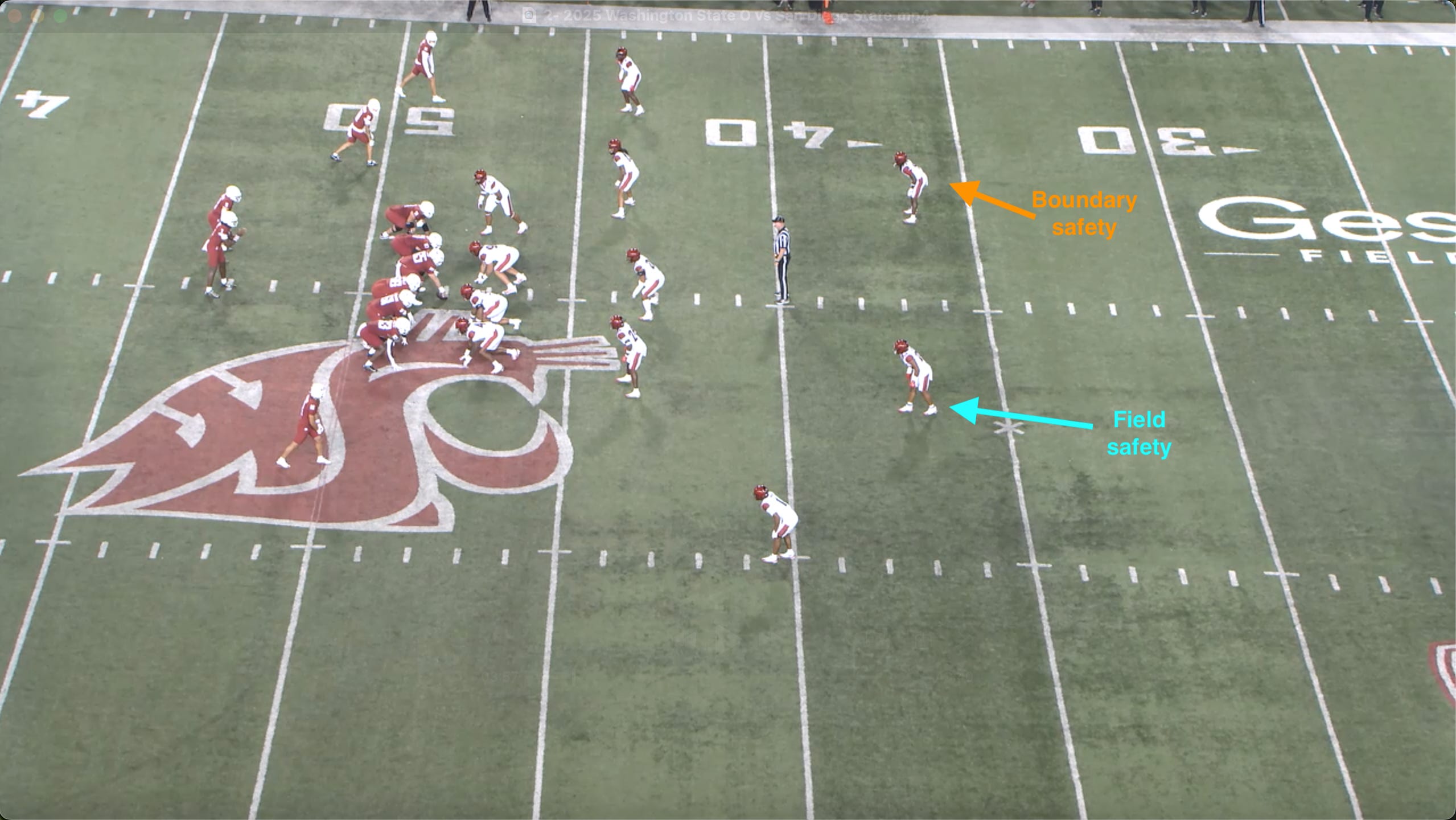
Nebraska transfer Dwayne McDougle was the field safety for the Aztecs this year.
From those interchangeable two-high safety looks, SDSU either remained in two-high to play match-based Cover 4 (also called “Quarters” coverage) or rotated into single-high to play match-based Cover 3. A “match” coverage is a zone coverage that locks into de-facto man coverage based on certain route patterns. Those two coverages or their variations constituted 68.5% of SDSU’s snaps, creating a fairly simplistic picture of a secondary that showed offenses the same two-high alignment before almost every snap and did one of two (very different) things after the snap.
Here’s what it looked like when SDSU stayed in Cover 4 out of two-high. Watch as both corners and both safeties initially backpedal into quarters of the field:
And here’s what a rotation to Cover 3 from two-high looked like. Watch as the boundary safety rotates into the box to play a down hash technique while the field safety rolls to the deep middle:
This defense will play one of those two coverages on approximately three-quarters of its snaps.
NU’s secondary under White and Butler was extremely rotation heavy — especially under Butler at 47% of all snaps last year featuring some form of coverage rotation. SDSU last season rotated slightly less than Nebraska at 42% of snaps, but that’s still a fairly high rate.
The difference was in the complexity of the rotations: 2025 Nebraska used a lot of different rotations from a lot of different pre-snap looks to get to a lot different coverage rotations, while San Diego State used basically one alignment to do one rotation into Cover 3 Buzz. I’ll talk more about the coverages and rotations in the dedicated coverage post coming later, but almost 80% of all of SDSU’s coverage rotations were 2-to-1 rotations.
Overall, SDSU played zone coverage on 77% of its snaps. In clear passing late or long situations, SDSU mixed in a little man with Cover 1 looks, plus one snap I saw of 2-Man. It also had a pressure package rotation to a Cover 2 Tampa Buzz look that Aurich used in every game I watched:
But largely this defense just relied on split-safety Cover 4 and rolls to Cover 3.
That coverage deployment would also be identical to Parker’s Iowa defense. Iowa is also a split safety, two-to-rotate defense that heavily uses Quarters and Cover 3. Other heavy two-to-rotate, Cover 3 and Cover 4 defenses you may be familiar with include Mark Dantonio, Pat Narduzzi, and, at the NFL level, Vic Fangio and Robert Saleh. Aurich definitely seems in that mold with his back seven, as well.
One other important thing to discuss with the secondary is how that Quarters and Cover 3 was played. The SDSU back seven in this scheme played very aggressively downhill, firing toward the line of scrimmage on almost any run action and especially in likely run situations. They also bit down hard on short-depth and stopping routes. Cover 4 can almost play like aggressive one-on-one man coverage at times, and SDSU had no compunction about jumping routes in Quarters. Look at how the corner and safety to the top of the screen close on the break here:
The safeties would also fire to the middle of the field on basically any sign of a running play when in Cover 4 or as the rotator in Cover 3. Their firing to the line of scrimmage was almost tough to differentiate from blitzes it happened so fast on some snaps. Watch how quickly one or both safeties in the clips below is triggering on run action:
It seemed an intentional priority of the back seven to fill in on the run and cut off any short-area passing, very aggressively, at the risk of getting beat deep. This, too, has been a hallmark of Parker’s defenses at Iowa. Iowa’s defense plays almost psychotically downhill in the back seven, especially out of Quarters. Take a look at a Quarters snap like this by Iowa:
and compare it to the SDSU clips above. There’s a lot of that same aggressive downhill mentality in how Aurich deploys his split safety coverage.
Blitzes/Pressure Package
In the blitz and pressure package game, SDSU was very much not a blitz heavy team, sending an extra rusher or running a sim or creeper pressure on just 26.7% of all snaps that I charted. SDSU brought a pressure on 34.7% of third and fourth downs. For comparison, Nebraska last season sent an extra rusher or ran a sim/creeper on 41% of its total snaps by my charting, and that rate was at 42.6% and 36.8% in White’s two seasons as DC. Nebraska also brought some sort of pressure on 52% of third and fourth downs. Nebraska was probably a blitz-heavy team under the last two DCs, and last year’s blitz rate was inflated because of its struggles up front to some degree, but even eliminating that, Aurich’s defense would represent a drop off in pressure rate, from a heavy blitzing philosophy to a limited blitzing philosophy.
How he blitzed/pressured (in the few times he did blitz/pressure) was also pretty conservative. SDSU last season used a sim or creeper pressure on 11% of its total snaps. Sim or creeper pressures are pressure package tactics that bring only four rushers but do so from unexpected spots, with conventional rushers or muggers dropping into coverage. It’s a way to generate offensive confusion and pass rush while still keeping seven players in coverage. Here’s one example below, with four linemen aligned at the LOS, but at the snap, one end drops into coverage and the cornerback becomes the fourth rusher instead:
So it’s a “blitz” or “pressure” but only four players still rush.
Since SDSU’s pressure rate was only 26% of snaps and the sim/creeper rate was 11% of snaps, that means 42% of all of SDSU’s total pressures were still just bringing four rushers (but from unexpected spots). To compare that to the last several years of NU defense, the sim/creeper rate has been 12.4%, 13.1% and 7.1% of snaps, but that came came off total pressure rates closer to 40%, meaning these sims/creepers constituted far less of the blitz game for NU than they did for SDSU (around 30% for NU in 2023 and 2025 and 19% in 2024).
Overall, Aurich brought more than four rushers on just 62 of 300 total charted snaps, or about 20.7% of plays. That rate for NU last year was about 37.8%. This is going to be a defense that pretty much only brings four.
A low rate of blitzing and relying almost totally on a four-player rush would also be in line with Parker’s scheme at Iowa. A Hawk Central piece had Iowa’s blitz rate typically between 17% and 20% of snaps; Aurich was at 26% last year, slightly elevated right in line.
Stunts/Twists
One last element to be aware of where Aurich’s defense did seem unique was on the level of stunting and twisting it utilized. Per my charting, SDSU last season stunted or twisted on over 41% of snaps last season. Nebraska finished at around a 26% stunt/twist rate last season, but was around the 40% mark through the first eight games of the season before it cut the stunt rate way back. And SDSU didn’t just stunt and twist for pass rush on long and late downs; the usage was consistent on early downs throughout every game I watched. The high stunt rate could be personnel based — heavy stunting and twisting is a frequent tactic for coaches who don’t believe in their defensive line’s ability to win one-on-one — but San Diego State had a good Mountain West line, so that makes me inclined to believe Aurich is just a heavy stunter as part of his philosophy.
Stunting and twisting is an aggressive tactic by the defensive front to create penetration on the offensive line and chaos in the backfield, less about holding conservative contain on the line of scrimmage and more about risk-reward gambles for tackles for loss in run situations or pressures in passing situations. That would be a contrast with a team like Iowa, which wants its defensive line to essentially stalemate the blockers to gum up trenches to let its ‘backers fill and make tackles. Despite the other similarities to Parker’s defense, Aurich’s scheme far more often was relying on single-gap techniques on the defensive line as a way to generate penetration rather than stalemates. Heavy single-gapping and stunting would be more in-line with the classic 4-2-5 scheme and not necessarily the mirrored 4-3 elements I’ve presented here. If you’ll remember, part of Patterson’s innovation with the 4-2-5 was to put smaller but faster players on the field to cause chaos and disruption. Heavy single-gapping and stunting is one way that shows up in the 4-2-5 scheme, and Aurich has also adopted that part.
Nebraska’s stunt rate has been high every year under Matt Rhule, and Aurich also looks like a guy who’s going to do the same. Rhule came up in a 1980s Penn State program whose defense stunted and twisted heavily, so it’s very possible this is just part of his football ethos and part of what made Aurich attractive as a hire. I can imagine the NU head man watched film of SDSU’s defense and identifying the stunting and twisting as something that would transfer over to the way he wants to play D.
BROADER TAKEAWAYS
So there are a lot of similarities in how Aurich’s defense operates compared to Parker’s, notably the 4-3 principles, the “two-to-rotate” safety philosophy, the heavy reliance on aggressive, downhill match-based Cover 3 and Cover 4, and the low blitz rate. The big difference would be the heavy stunt rate and desire for more single-gapping techniques up front.
If you want the one-sentence comparison for what this defense is that would be easy for the average Nebraska fan to understand, it’s:
Aurich’s scheme is very similar in alignment, personnel, and function to Parker’s Iowa defense but with more stunting/twisting and aggressive single-gapping up front and a trickier pressure package on passing downs with designed sim and creeper pressures.
Single-gapping Iowa, if you want an even shorter tagline for how this D seems to play.
Several teams play versions of the same defense as Iowa, that just seems like the easiest comp for fans of this team to understand. Broadening out a little, a two-high, four-down team with a heavy stunt/twist/single-gap rate would also be reminiscent of how Penn State often operated under James Franklin, especially under Tom Allen. It also remains to be seen if Nebraska will keep any of the three-safety-shell concepts in its defense, which I believe it might because we saw them in the bowl game, which would also be similar to how Jim Knowles operated his defenses at Oklahoma State, Ohio State, and Penn State. It seems like there will be some hybridization of Parker’s scheme with some of these stunt/twist and three-safety elements, as well, if I were guessing.
So, if Nebraska’s going to play this way, what are the plusses and minuses of doing so?
To start with the good, Nebraska switching to a defense that plays primarily one front and two coverages and rarely blitzes is going to simplify mental responsibilities and be easy to teach, which will let players execute quickly and aggressively because they’re not having to mentally process a ton during the play. They will also be repping the same basic concepts over and over again in practice — instead of practicing a more diverse array of concepts but with fewer reps devoted to each concept, as they would in a complex defense — which will also reduce the “thinking” and help them play faster. Defenses like Iowa often execute simple concepts blur fast, and playing as quickly as possible is a key tenet to the coverages firing downhill so aggressively on short routes and the run.
That back-seven aggressiveness against the running game and short passes will also make it both more difficult for offenses to get steady gains and put together long, sustained drives. Few offenses and QBs are capable of doing the clockwork execution required to move the ball against good defenses from this style over and over again.
The downhill play of the secondary will also probably generate more turnovers. With the coverage flowing toward the line and aggressively, there’s going to be more jumping routes and catch-on-contact opportunities for the defense to knock balls in the air.
The most obvious downside, though, is that playing a scheme with this level of aggressiveness also leaves you open to big passing plays down the field. Triggering and biting on short routes, compounded with having a predictable coverage menu, is going to make it easy for offenses to scheme up big plays against you, especially in Cover 4. I’ll talk about coverages more in the third post in this series, but many people think Cover 4 is a “safe” defense to prevent big plays because the “4” in its name would indicate four players deep. But Cover 4 has specific rules about DBs “locking” onto receivers when threatened vertically, making it a coverage that often plays out like one-on-one man with no safety help. If Nebraska is going to play so much locked Cover 4, there are just going to be some plays like this:
This is Cover 4. Watch how the corner to the bottom of the screen gets locked into man coverage with his receiver on a post route because he’s threatened vertically, but the safety to his side also gets “locked” and can’t help to the inside, creating a one-on-one on a post route. If NU is going to play this way, there are big plays down the field for good offenses to take.
The second big downside to this style is that the lack of complexity will probably make this defense vulnerable to getting torched by the best offenses and the best quarterbacks. Playing limited coverage looks with airtight execution is a bid to swamp teams with poor or middling offensive teams, but good QBs who can operate on time and know where to go with the ball — or QBs with great offensive lines who get more time to operate and figure it out — will be more likely to torch a defense that only plays match Cover 3 and Cover 4 and rarely blitzes. Good offensive coaches will find ways to isolate corners on the outside in Cover 4 like above or manipulate match rules in C3 if they know they’re getting those looks at a 75% rate. If we’re staying with the Iowa comparison, the Hawkeyes defense in this recent stretch has dominated poor and mid-tier offenses but struggled at times against the best passing attacks it’s faced. It’s given up 35 and 54 points in its only two games vs. QB cradle Ohio State since switching to this version of the “4-2-5” in 2018. Last season, Iowa gave up late passing plays to good quarterbacks in all four of its losses, including allowing 239 yards and 19 straight points in the second half to USC’s no. 5 national passing offense. That’s not to say Iowa hasn’t had good performances against good offenses, but it has been susceptible to good passing offenses. If Nebraska switches to a similar defense, it’s likely to also struggle against the best passing teams.
I know John Butler is a persona non grata amongst NU fans right now, but Butler was largely credited with the gameplan against Colorado that shut down a top-10 passing offense in Colorado, and his defense also held that same USC passing offense last season to 9 of 23 for 135 yards. Whatever his defense’s issues, Butler had an ability to game up coverages in ways that flummoxed good passing teams, with DB personnel I don’t think anyone would say was elite. I think switching from what NU ran last year to Aurich’s system might give Nebraska a higher floor on defense but will likely lower the ceiling of performance against the best passing offenses NU plays.
Which is a fine bet to make. The run defense last year was clearly not good enough, and if Rhule thinks this has a good shot at fixing it, you’ll take a lowered ceiling. But I think Nebraska fans need to be ready that this is a defensive scheme that is so simplistic it will probably be at a big disadvantage in some matchups and will be in jeopardy of giving up some big games through the air with little recourse. A need to get more simplistic on defense from last year has seemed to be a rallying cry from the message boards and some media, but I also don’t think those people are going to like it much if Julian Sayin rips apart Match 3 and 4 next year.
Thanks, as always, for reading. I felt a little bad publishing a football post on the day after the biggest men’s basketball win in school history! Everyone responsibly celebrate the basketball team. Parts 2 and 3 of this series will be out next week before the spring game. Those will be shorter and more in line with the tendencies post comparing hard data or specific concepts. I’m shooting to publish Tuesday and Friday morning, but that’s not set in stone.
If you’re a new reader and enjoyed this free post and want to continue reading this series, you can get access by clicking “subscribe now” below. Paid subscriptions are a (very cheap!) $5 a month or $50 a year. A paid subscription also gets you access to all past paid content and lets you ask me questions about the article or team in the comments.
If you read my history of the 3-3-5 post from a couple of years ago before Nebraska switched to that scheme, you’d know that the New Mexico was also the birthplace of the 3-3-5. Albuquerque, cradle of modern college football defenses?
11 personnel means one running back, one tight end, and three receivers on the field for the offense.
12 personnel means one running back, two tight ends, and two receivers on the field for the offense.
Then-Washington State coach Jimmy Rogers was previously at South Dakota State and is now the head coach at Iowa State, for Midwest football fans. It’s a fun offense.