

The Schedule May Not Be Much Worse
Nebraska’s two toughest games next season are sure to be more difficult than in 2025. But many are underplaying last year’s slate and overplaying the likelihood of opponents repeating their '25 highs

Nebraska’s 2026 schedule strength has dominated — or even soured — a lot of the offseason mood outside of the football building.
A common sentiment or fear is that any improvements in play may be swallowed up in the win column by a Big Ten slate that includes three of last season’s College Football Playoff participants and three other opponents that won nine games. Vegas set the early win total for NU at 5.5 games — essentially making the bet whether a Nebraska team under a fourth-year coach will regress from two years of bowl eligibility.
This isn’t an argument that 2026 won’t be a tough schedule. The headliners are Indiana, Ohio State, and Oregon — the Nos. 1, 2, and 5 seeds in last year’s CFP field, who went a combined 35-1 last year in the regular season, with the lone loss when Oregon fell to … Indiana. Nebraska’s games vs. Ohio State and Indiana are at home, but facing a quarter of the previous season’s playoff field in any context is a tough road. On top of that, Nebraska goes to Illinois and Iowa and plays Washington in Lincoln, each of whom won nine games last year when including bowls.
But there’s also a case that fan and media sentiment has also probably swung too far into overrating the difficulty of next year’s schedule, and there’s quite a bit of compelling data to suggest the slate won’t be as bad as it currently seems. NU will undoubtedly face a tough schedule in 2026 — and almost definitely tougher overall than last year — but there’s also plenty of context and data to suggest the 2026 schedule probably will only be degrees worse than the lineup NU played in 2025. To be specific, that Nebraska’s schedule in 2025 was already fairly challenging and that returning production would suggest it’s very unlikely all of Nebraska’s 2026 opponents repeat their 2025 highs, specifically Indiana, Illinois and Iowa.
The first crux of the argument is that last year’s schedule was tougher than many are giving it credit for.
The raw data would say Nebraska’s 2025 slate was fairly easy for a Big Ten team: SP+ had NU’s strength of schedule last year at 47th nationally, ESPN’s FPI had it at 42nd, and FEI placed it either 29th, 31st or 38th depending on the quality of team playing the schedule. Those rankings were all on the lower end of the conference. Nebraska avoided all three of the Big Ten’s playoff participants (extremely fortunate), played two atrocious teams in non-conference (Akron finished 117th in SP+ in the FBS, and Houston Christian went 2-10 and finished 114th in FCS per SP+1), and three of NU’s conference opponents (Michigan State, Maryland, and UCLA) won a combined five Big Ten games. Nebraska did not face a great team in the regular season and got to face several very poor teams. Those were undeniably scheduling breaks.
But that also doesn’t mean it was an “easy” schedule or that Nebraka biffed a slate where it played no one good, which seems to be a fairly common sentiment I’ve seen.
While there wasn’t a playoff team in the fold, NU did have to face several teams that very easily could have made the CFP or had underlying numbers that suggested they were playoff quality. Five of Nebraska’s 13 opponents finished inside the top 25 for Bill Connelly’s SP+ rankings, including four inside the top 16:
No. 8 Utah
No. 12 Iowa
No. 15 Penn State
No. 16 USC
No. 25 Michigan
To get granular:
outside of Notre Dame, Utah was the best team to be left out of the playoff by pretty much every advanced statistical ranking and was rated higher than playoff participants Miami, Texas A&M, and Oklahoma in SP+;
Iowa last year fielded one of the very best teams of Kirk Ferentz’s 27-season tenure by advanced metrics;
Penn State did not live up to its No. 1 preseason ranking and had a program-wide freakout after losing to Oregon and fired its coach, but it still more-or-less played like its usual “top-10 but not top-five” self outside of that three-week stretch; 2
USC kept up its elite offense and got competent defense for the first time in Lincoln Riley’s tenure, staying in the playoff hunt until late in the year; and
Michigan was down compared to recent standards but still played largely consistent top-25 football and had six players drafted.
Those five were good and talented teams who were all varying degrees of plausible to make the playoff field.
On top of those five teams, Cincinnati was in the top 30 by several advanced metrics for a majority of the season and only fell out in its final two games, a loss to TCU and bowl performance without several of its key players, including quarterback Brendan Sorsby. Those final two games dropped it fairly significantly, from the 28th-best team in the country to the 48th per FPI. But over its first 10 games (when Nebraska played them), the Bearcats were playing like a top-30 team and were contending for a Big 12 title berth.
Going beyond just statistical service numbers, last year’s slate was a pretty tough draw for play style and matchups for NU also.
Last year, Nebraska’s biggest weakness as a team was the inability of its defensive front-seven to fit the run. Its best skill was overall pass coverage isolated from the pass rush.
In that year where it struggled to hold up against the run and was great in isolated coverage, it faced two offenses in the top five nationally in rushing efficiency (No. 1 Utah and No. 3 Cincinnati), two more in the top 25 (No. 12 Michigan and No. 21 USC), and three more that finished in the top 50 (No. 34 in Penn State, No. 45 Northwestern, and No. 50 Iowa). The only top 50 passing offenses Nebraska faced last year were No. 5 USC and No. 35 Maryland.
Playing seven teams that were in the upper echelon of the on-field element you were worst at stopping and only two teams you matched up best with is probably a tough scheduling break and more challenging than the holistic “strength of schedule” numbers are quantifying. Football is largely about styles and matchups of teams, and NU pretty undeniably, to me, faced a slate full of tough matchups for its team construction/performance last year.
That paints an overall picture of a 2025 schedule that probably didn’t have a great team and had several very easy opponents but also probably did have a high rate of pretty good teams or tough matchups. You can argue (and I’d probably agree) that the slate was probably on the lighter/fortunate end for what you’ll get in the non-division Big Ten now, but I also find the arguments that the 2025 schedule was easy or that Nebraska faced no tough games and should have coasted through cupcakes to be quite dubious. You can call it a blown opportunity, but that doesn’t mean it wasn’t still challenging.
Now, let’s compare that schedule of five top-30 games to this year’s slate.
First, let’s be clear that nothing in this argument applies to Ohio State or Oregon. With the level of talent they are pulling from high school recruits as a base and now from lower colleges with the portal to fill their weak areas, those two programs are essentially locks to be elite teams year in and year out. OSU and Oregon project as the No. 1 and No. 2 teams in SP+ preseason. Those will be the toughest pair of games anyone in the country plays based off the data we have right now and better than NU’s best regular-season opponent last year (No. 12 Iowa and No. 15 Penn State). There’s really no argument that the top end of Nebraska’s schedule won’t be more challenging in 2026.
People should also be cognizant that Nebraska’s lesser games look to be quite easy again. Ohio won nine games last year but fired its coach for misconduct in December, lost basically all of its players, and projects 117th in the SP+ preseason rankings. Bowling Green went 4-8 under first-year coach Eddie George and projects 115th. North Dakota had a good season at the FCS level and almost scored a win vs. K-State last year (and returns a lot of its best players), but it still finished 118th in SP+ cumulative ranking for FBS and FCS teams.3 None of NU’s three non-conference opponents projects as a top-100 team in the sport.
Plus, two of Nebraska’s five Big Ten road games are against Michigan State and Rutgers, both projected to finish second-to-last and third-to-last in the conference by advanced metrics. Bad Big Ten teams are still pretty good relative to the rest of the sport and by no means NU lock wins, but if you’re playing conference road games, it’s fortunate to have almost half of them be against two of the three bottom teams in the conference. It also gets Maryland — projected to be the fifth-worst team in the Big Ten — at home.
That leaves four other games on the schedule:
vs. Indiana (5th in SP+ preseason projections);
vs. Washington (21st);
at Illinois (33rd); and
at Iowa (22nd).
Tallying all that up, based purely off the preseason projections, 2026 looks like a much harder schedule. If we add those four opponents I just mentioned to the two games against elite programs in Ohio State and Oregon, that’s five total games against teams projected in the top 25 of SP+, plus another game against a team just outside the top 30 in Illinois. If (excluding the bowl against Utah but including pre-collapse Cincinnati) Nebraska played five-ish top-30 teams last year in the regular season (Iowa, Penn State, USC, Michigan, and Cincinnati), it will play six top-30ish teams in the regular season this year, with three of those top-30ish opponents being top-five teams, based off the hard data of the preseason projections.
The crux of my argument that things will not be quite that bad centers on three teams: Indiana, Illinois, and Iowa. Namely, that it will be extremely difficult or unlikely for those three teams to repeat their 2025 performances and their preseason projections are being inflated by past success data points.
While all three of those teams rank relatively high in the preseason SP+ rankings, a huge chunk of the SP+ preseason projections formula is just your recent history of performance. Which makes some sense as a methodology: If you were good in the recent past, you’re likely to be good in the future.
But I also think it’s worth pointing out that a massive chunk of the players who drove the success of Indiana, Illinois, and Iowa the last two years are no longer on their rosters. Those three teams return some of the lowest totals of their production from 2025 in the Big Ten, and in Illinois’ and Iowa’s case in the power conferences:
Indiana is 52nd nationally in returning production, 69th on offense and 39th on defense. The Hoosiers will have 12 new starters, at quarterback, running back, two receivers, tight end, center, right tackle, both edge rushers, one linebacker, one corner, and one safety.
Illinois is 75th in returning production, 74th on offense and 83rd on defense. The Illini will have 15 new starters, at quarterback, one receiver, tight end, left tackle, left guard, center, right tackle, nose tackle, both 3 techniques, both edge rushers, both linebackers, one safety, and one corner.
Iowa is 104th in returning production, 84th on offense and 105th on defense. The Hawkeyes will have 14 new starters, at quarterback, two receivers, left guard, center, right tackle, both defensive ends, nose tackle, 3 technique, one linebacker, one corner, and both safeties.
All three teams are in the bottom six of the Big Ten in returning production from last season,4 with the other teams around them two squads with new head coaches and remade rosters (Penn State and Michigan State) and Rutgers. Iowa specifically returns the second-lowest level of returning production in the entire power conferences, ahead of only Vanderbilt.
For Indiana, its hope is that its portal class — ranging from anywhere to best in the country to top 10 depending on the recruiting service — will 1-to-1 replace losing the majority of the players who fueled its national championship run. Indiana did bring in a lot of talent to fill its losses, and betting against Curt Cignetti being able to reload through transfers last year put a lot of egg on a lot of people’s faces, but I think it is worth pointing out that Indiana’s portal situation this offseason is a bit different than the first two years of Cignetti’s tenure.
Upon arrival at Indiana before the 2024 season, Cignetti was able to bring his best players from his previous team, James Madison, which finished 20th overall nationally in SP+ and would have been the fourth-best team in the Big Ten that year per the advanced numbers. Those 2023 JMU transfers were part of the backbone of Indiana’s run the last two years, players like D’Angelo Ponds, Elijah Sarratt, Aiden Fisher, Mikail Kamara, James Carpenter, and Tyrique Tucker following Cignetti and starting most if not all of the games over the last two years. Those players all counted as “transfers,” but they were really players who Cignetti had recruited and developed and had a previous familiarity with. On top of that floor the JMU players set, Cignetti nailed most of his outside transfers, too, leading to the quick turnaround we all saw.
But pretty much all of those JMU guys (except Tucker, who’s back) just got drafted to the NFL, and Cignetti will have to rebuild the whole team now with guys he didn’t previously coach. IU’s projected lineup features incoming transfers at quarterback, running back, two receiver spots, tight end, one offensive guard spot, both edge rusher spots, one linebacker spot, one corner spot, and at least one safety spot.
And from that lens, continued success through Cignetti’s method of veteran transfer roster building seems much more dubious. We’ve seen coaches nail a single or consecutive transfer class on top of a solid floor of talent to build a national contender — Mel Tucker at Michigan State, Mike Norvell at Florida State, for example — out of a surprise team before. But all have seen that strategy collapse on them in the second or third year when they haven’t been able to plug all the holes that sprung up from the massive attrition from graduation or the NFL departees. Cignetti accomplished much more through this method of roster building than anyone else in the sport ever has (and he got a title out of it), but it’s also true that no one’s ever fielded a true contender three years in a row through the “we’ll just do it all through veterans in the portal” method. If Indiana is an elite team this year, they’ll be doing something no one’s ever done before. Perhaps Cignetti is really just different than everyone else in the sport and I’ll tip my cap to him, but I think there’s pretty valid reason to believe Indiana will not be at a contender level this year. That drop off may be to, say, the 20th-best team in the country, but it still wouldn’t mean a third top-five opponent for Nebraska.
For Illinois, Brett Bielema’s teams there have struggled when he hasn’t returned veteran squads. His tenure has been successful for Illinois overall with some high-end years, but people also gloss over that he’s also had some pretty poor teams and has definitely followed up-and-down “reload” cycles. By SP+, his first team at Illinois finished 64th and went 5-7, followed by a veteran team that finished 21st and went 8-5, followed by a young team that finished 69th and went 5-7, followed by a veteran team that finished 31st and 24th and won a combined 19 games. The Bielema tenure, for as high as his reputation has become, has looked like this since 2021:
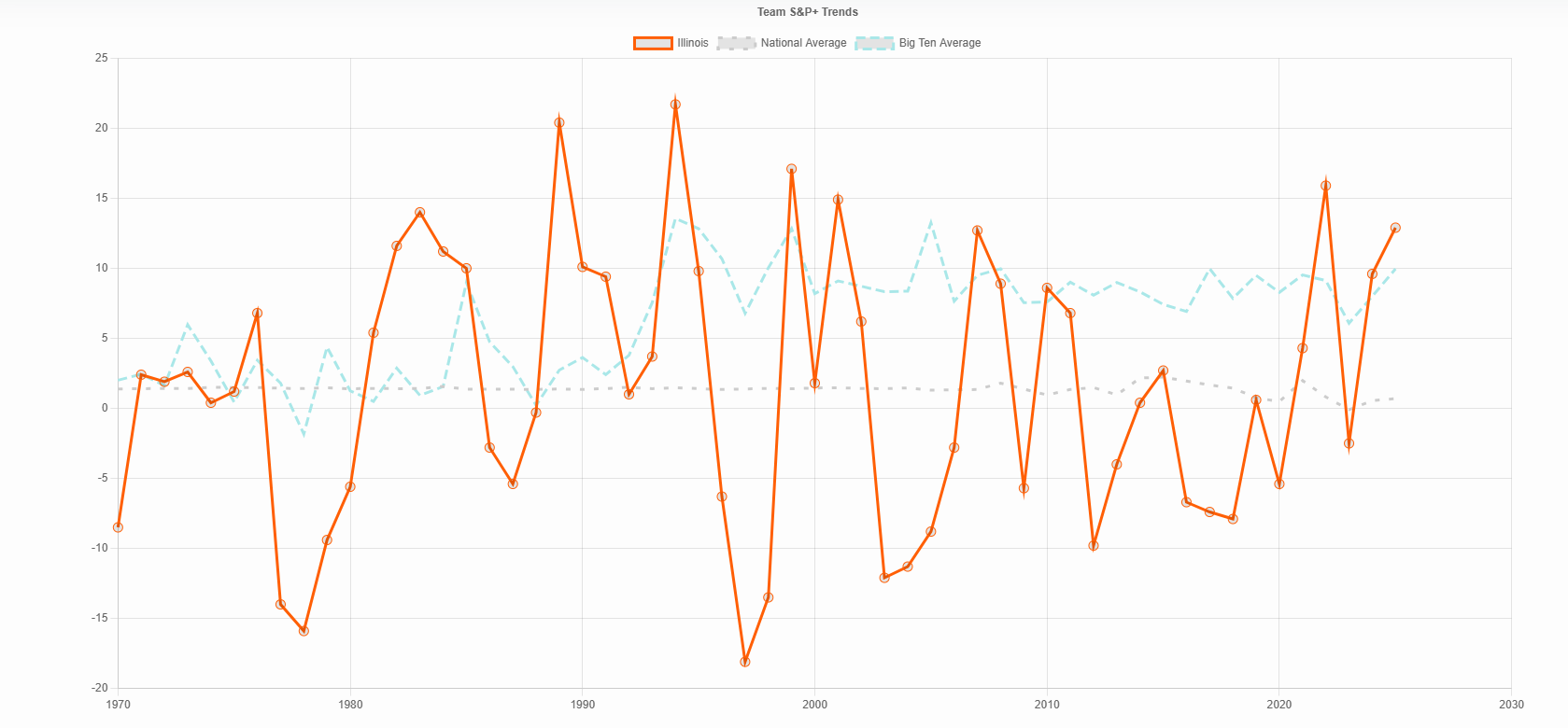
With the 15 new starters, next season looks to be the down part of that cycle, which would indicate Illinois is a bit overvalued compared to its preseason ranking of 33rd. Bielema, like Cignetti, is also leaning heavily into the portal to fill his departing experience, though he’s losing more overall production than IU and replacing it with lower-ranked transfers in. Illinois brought in 20 players from the portal in a class ranked just 43rd per 247Sports (though 31st through On3). I don’t know how much to trust transfer rankings, but it certainly doesn’t seem like a lot of readymade impact starters despite the heavy reliance on the portal. The microwave job could work, but I also think there’s also pretty good reason to doubt that Illinois will play up to that borderline top-30 preseason projection from what we can tell right now.
Iowa is a bit of a different case than the other two because it has a much more proven history of high school player development and should be a lot more capable of replacing its departees without having to rely on outsiders.
Still, the data would say Iowa has to replace a lot — and brought in little FBS experience through the portal to offset the losses. Iowa ranks lower in returning production than Iowa State, which lost 54 transfers when Matt Campbell essentially ported over the ISU roster with him to Penn State. That’s a pretty massive level of attrition for anyone, even a good developmental program.
Everything we know about Iowa’s program would tell us we should expect players to be developing behind the scenes who a ready to step into those roles, so there’s probably a reasonable floor. But it’s also worth pointing out that the last time Kirk Ferentz dealt with this much attrition was 2023, when Iowa returned just 57% of its production, 94th-best nationally and second-to-last in the Big Ten. That 2023 Iowa team finished 47th in SP+, the worst finish by an Iowa team since 2012. The last time Iowa had this much talent leave its program is the data point highlighted below:
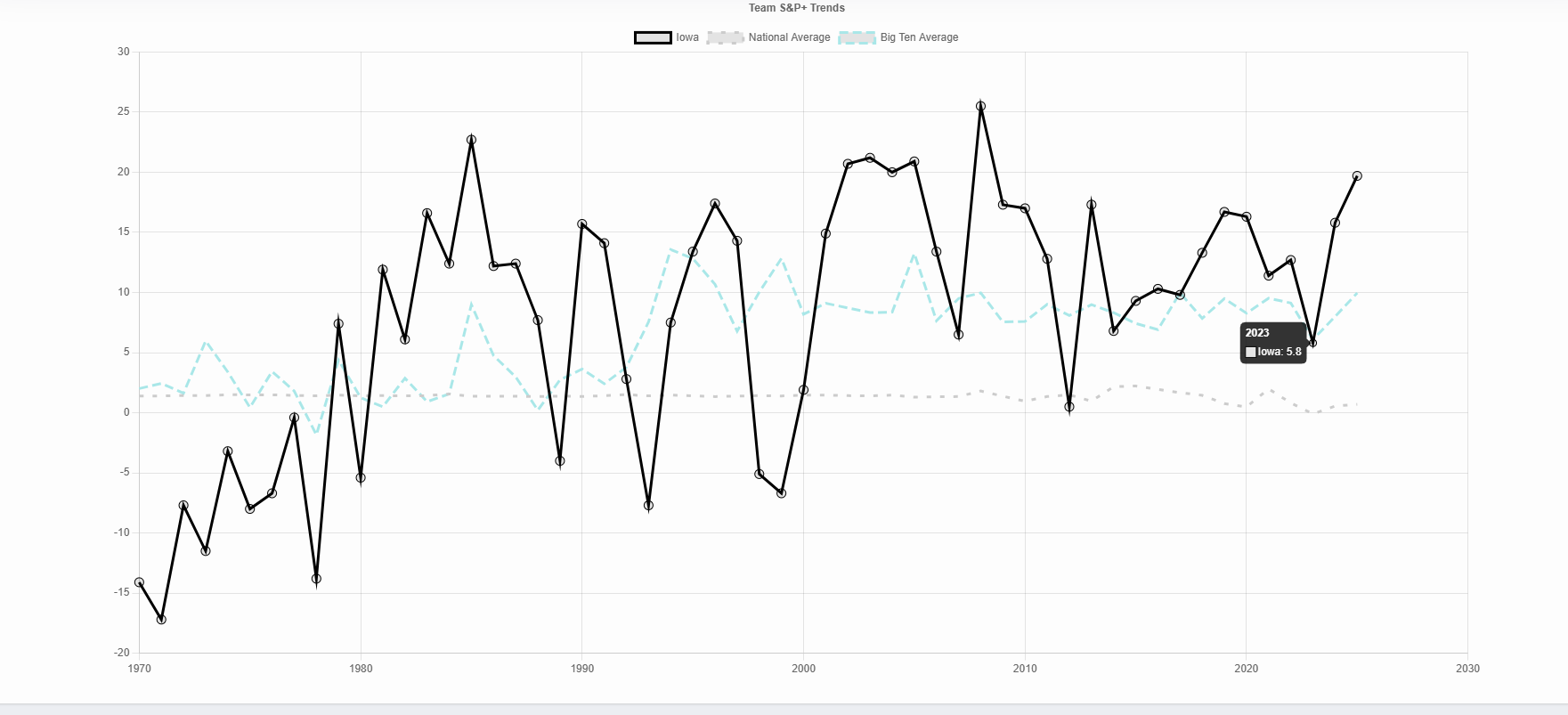
The last time Iowa had to replace this much, Iowa was a significantly worse team compared to its recent history. 5 There’s a pretty reasonable possibility of a fall to the 30s or 40s for Iowa, as opposed to last season’s top-12 ranking and No. 22 preseason projection, namely because we just saw that exact thing happen two years ago. 6
So, back to the comparison to 2026.
Any one of Indiana, Illinois, or Iowa — each of whom have reasonable to even strong cases to regress from their 2025 performances — regressing would make Nebraska’s schedule significantly less of a burden.
If we lock in Ohio State and Oregon as top-five games, and reasonably expect Washington to be anywhere in the top 30, then just one of Indiana, Illinois, and Iowa falling out of the top 30 would make the 2026 slate have the same number of top-30 opponents as the 2025 slate in the regular season. If two fall out, then Nebraska would have fewer games against top-30 teams than in 2025.
Let’s say, for instance, (1) Indiana falls to a merely very good 22nd in SP+, (2) one of Illinois or Iowa gets bit by the lost production bug and falls to the 40s, and (3) the other finishes somewhere 25th to 35th. A fairly plausible outcome based on the data and argument I presented above.
The top five toughest games on NU’s 2026 schedule by SP+ preseason projections would then be:
No. 1 Ohio State
No. 2 Oregon
No. 21 Washington
No. 22 Indiana
No. 25 to 35 Iowa/Illinois
Compare that to 2025’s slate:
No. 12 Iowa
No. 15 Penn State
No. 16 USC
No. 25 Michigan
No. 28* Cincinnati (pre-bowl meltdown)
The top of the 2026 schedule is clearly much tougher, trading the No. 12 and No. 16 teams for the No. 1 and No. 2 teams. But the total number of top-30 matchups is the same, essentially just swapping out games against the No. 12 and No. 15 teams for games against No. 1 and No. 2. You’d clearly rather play the former, but NU would already be playing a very, very good team in a game against No. 12 or No. 15. Is it that much worse to trade that for Ohio State and Oregon?
Preseason schedule talk is obviously a lot of speculation, and it’s even tougher now to know what the schedule will be like with the advent of the portal. This time last year, we were talking about Penn State as the best team in the country. This time in 2024, we were talking about Indiana being Nebraska’s easiest conference game. We sort of have no idea what will happen. My arguments can also cut the other way — Washington is 15th nationally in returning production and could pretty easily jump into the contender tier,7 and Maryland is No. 2 in returning production and could jump into the top 30 from 55th. It’s sort of all unknown.
But, looking at it now, my best guess is that this schedule has two tougher games than any NU played in 2025 but about the same number of top-30 opponents total. Definitely harder, but a lot more manageable than many are letting on.
Thanks, as always, for reading. I’m trying to write a few more posts this offseason that don’t require hours of film watching to get out some more consistent content; this is one of these. I have a couple more planned in the summer months on topics that won’t require charting or film. My next post will be an Inflection Points on transfer defensive tackle Jahsear Whittington. I’m hoping to have that out in two weeks from today, though it may be three. You can read the last Inflection Points, on Anthony Colandrea, here.
HCU also finished behind 12 NAIA teams in the composite rankings. That matchup was essentially a Big Ten team vs. a high-end NAIA squad.
Penn State finished as the best 6-6 team in history per SP+ last season.
Don’t be shocked in UND is the best team NU plays in the first three games.
The Big Ten returning production rankings are No. 2 Maryland, No. 3 Nebraska, No. 7 Minnesota, No. 9 UCLA, No. 11 Oregon, No. 13 USC, No. 15 Washington, No. 20 Michigan, No. 31 Ohio State, No. 35 Wisconsin, No. 40 Purdue, No. 44 Northwestern, No. 52 Indiana, No. 67 Penn State, No. 75 Illinois, No. 92 Rutgers, No. 97 Michigan State, No. 104 Iowa.
Though it still managed to win nine regular season games thanks to a 6-1 record in one-score contests.
Though it also should be worth noting that Iowa was also in the 100s in returning production entering the 2021 season and finished in the top 20 in SP+. If there’s a decent chance for regression there’s also one for the No. 22 preseason ranking to be accurate.
I would not be surprised at all if Washington is the third-best opponent on Nebraska’s schedule next season.
Interesting read and analysis! Provides good context and some reason for hope :)